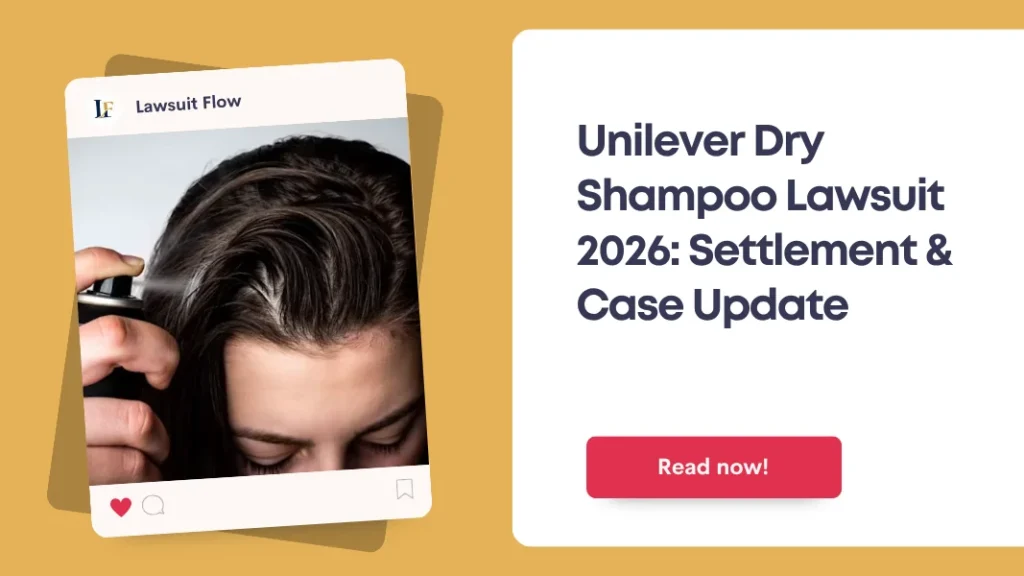
The Unilever dry shampoo lawsuit centers on allegations that certain aerosol dry shampoos sold under Dove, Nexxus, Suave, TRESemmé, TIGI Bed Head, and Rockaholic contained benzene. Unilever voluntarily recalled select lots in October 2022 after identifying potentially elevated benzene levels in certain products.
Consumers have since searched for updates about the litigation, proposed settlement, eligibility requirements, claim forms, payout dates, health concerns, and whether the case remains active in 2026. The legal situation has changed significantly since a $3.625 million settlement was proposed.
Most importantly, that settlement did not receive preliminary approval. In June 2026, the federal court dismissed the claims of ten named plaintiffs for lack of standing while allowing the remaining plaintiff’s litigation to continue under a revised schedule.
Unilever Dry Shampoo Lawsuit 2026 Update: Where the Case Stands Now
The Unilever dry shampoo litigation has not resulted in an approved nationwide consumer settlement as of September 2026. A proposed $3.625 million deal was presented to the U.S. District Court for the District of Connecticut, but the court declined to preliminarily approve the settlement.
The proposed class was considered too broad because it potentially included consumers whose products were not sufficiently connected to evidence of benzene contamination. The court concluded that only one of the named plaintiffs, Billie Barnette, had adequately alleged an injury sufficient for standing at that stage.
A later June 24, 2026 ruling dismissed the claims of ten other named plaintiffs. The court also denied their request to file another amended complaint but established additional deadlines for the remaining litigation, including discovery and a future class-certification motion.
| Issue | Status in 2026 |
|---|---|
| $3.625 million settlement | Proposed but not preliminarily approved |
| Settlement claim form | No court-approved claim process |
| Settlement payout date | None announced |
| Ten named plaintiffs | Claims dismissed for lack of standing |
| Billie Barnette | Claims remained subject to further litigation |
| Class certification | Scheduled for later proceedings |
| 2022 recall | Applied to select lots produced before October 2021 |
Is the Unilever Dry Shampoo Lawsuit Still Active?
The consolidated litigation was still proceeding after the June 24, 2026 ruling, but in a substantially narrowed form.
Judge Michael P. Shea dismissed the claims brought by Elizabeth Little, Cathy Armstrong, Clair Awad, Kelly Branch, Suzanne Fitzgerald, Mari Gunn, Sarah Hernandez, Stacy Vail, Christina VanVliet, and Robert Rullo. The dismissal was based on Article III standing rather than a factual finding that benzene contamination did or did not occur.
Billie Barnette was treated differently because the court previously found that she had plausibly alleged an injury-in-fact. The June order allowed defendants to renew a motion directed at her claims and established further litigation deadlines.
Accordingly, describing the entire case as either “settled” or completely “over” would be inaccurate based on the June 2026 order.
What Happened to the Proposed $3.625 Million Settlement?
The parties proposed a $3.625 million settlement intended to resolve claims involving certain Unilever dry shampoos. The proposed class would have covered U.S. consumers who purchased qualifying Suave, TIGI, TRESemmé, Dove, or Nexxus dry shampoos between January 1, 2014 and December 31, 2022.
The court denied preliminary approval in February 2026. Judge Shea found problems with the breadth of the proposed class and the evidence supporting such a lengthy class period. In particular, the record did not adequately support an inference that products throughout the entire proposed period were contaminated.
The denial was initially without prejudice, leaving room for a narrower proposal. However, subsequent standing rulings significantly reduced the number of named plaintiffs who could continue asserting claims.
What Did the Court Decide in June 2026?
On June 24, 2026, Judge Shea granted the defendants’ motion to dismiss the claims of ten named plaintiffs for lack of standing. The court also denied plaintiffs permission to file the proposed second amended consolidated complaint.
The judge found that the plaintiffs had not shown sufficient diligence to justify reopening the deadline for amending their pleadings. The proposed additional allegations also did not adequately cure the standing problems identified by the court.
The ruling nevertheless extended several case deadlines. Fact discovery was scheduled through September 23, 2026, expert-related proceedings extended into January 2027, and the plaintiff’s class-certification motion was scheduled for February 19, 2027.
What Is the Unilever Dry Shampoo Lawsuit About?
The litigation concerns allegations that consumers purchased Unilever-branded aerosol dry shampoos that contained benzene, a chemical classified as a human carcinogen.
The consolidated case is Little et al. v. Unilever United States, Inc., et al., Case No. 3:22-cv-01189-MPS, in the U.S. District Court for the District of Connecticut. Defendants have included Unilever United States, Inc., Aeropres Corporation, and Voyant Beauty, LLC.
The consumer claims should be distinguished from the recall itself. The October 2022 recall is an established event. Claims that particular consumers were legally harmed, overpaid, or purchased contaminated products are allegations requiring evidence and satisfaction of applicable legal standards.
Why Did Consumers Sue Unilever?
Plaintiffs generally alleged that they purchased dry shampoos they would not have bought, or would have valued differently, had they known of the alleged benzene contamination.
This type of consumer case focuses largely on economic injury. Plaintiffs must establish more than the existence of a recall. They need sufficient facts connecting their purchases to allegedly affected products and showing an injury recognized by law.
That distinction became particularly important in 2026. The court found that most named plaintiffs had not alleged enough product-specific or purchasing information to establish Article III standing.
What Did the Lawsuits Allege About Benzene?
The lawsuits alleged that certain aerosol dry shampoos contained harmful or elevated levels of benzene and that consumers were not adequately informed about the issue before purchasing the products.
Benzene is recognized as a human carcinogen. Long-term exposure to sufficiently high levels can affect bone marrow and blood production and is associated with leukemia.
However, the existence of benzene-related health risks generally does not prove that a particular consumer’s dry shampoo exposure caused an illness. Exposure level, duration, route of exposure, individual circumstances, and medical evidence can all matter in evaluating a personal injury claim.
Which Unilever Dry Shampoo Brands Were Involved?
The October 2022 recall covered select aerosol dry shampoo lots sold under:
- Dove
- Nexxus
- Suave
- TRESemmé
- TIGI Bed Head
- TIGI Rockaholic
The products were manufactured before October 2021, and the recall applied to specific products and lot codes rather than every hair-care product sold under those brands.
The proposed settlement similarly referenced Suave, TIGI, TRESemmé, Dove, and Nexxus dry shampoos, but the settlement did not receive preliminary court approval.
Unilever Dry Shampoo Lawsuit 2022: How the Litigation Started
The legal controversy developed alongside concerns about benzene in aerosol personal-care products.
One of the actions that became part of the consolidated case was filed in September 2022. Additional cases followed as information about potentially contaminated dry shampoos became public.
Unilever then announced its nationwide voluntary recall on October 18, 2022. The FDA published the company announcement on October 21. The recall brought substantial attention to benzene contamination and prompted additional consumer litigation.
What Triggered the Unilever Dry Shampoo Lawsuits?
The lawsuits were driven by allegations that consumers purchased dry shampoos containing benzene without knowing about the potential contamination.
The litigation also developed against a broader backdrop of benzene concerns involving aerosol consumer products. Independent laboratory testing and product recalls increased public scrutiny of how benzene could enter aerosol formulations.
For the Unilever products specifically, the company’s internal investigation identified the aerosol propellant as the source of the benzene detected in affected products.
When Were the First Class Actions Filed?
The federal case now known as Little et al. v. Unilever United States, Inc. carries a September 21, 2022 filing date. Other related actions were filed in different jurisdictions and eventually became part of consolidated proceedings.
Consolidation allowed overlapping claims involving similar products, defendants, factual allegations, and legal questions to be handled more efficiently in one federal proceeding.
The consolidated nature of the litigation does not mean every plaintiff had identical purchases or circumstances, a distinction that later became central to the court’s standing analysis.
How Did the 2022 Recall Affect the Lawsuits?
The recall provided official confirmation that Unilever had identified potentially elevated benzene levels in select aerosol dry shampoo products.
That strengthened the factual basis for claims concerning specifically recalled products, but it did not establish that every dry shampoo sold by the company during every year contained benzene.
This distinction became critical when the court reviewed the proposed settlement class. Judge Shea found insufficient allegations or evidence to extend the contamination inference as far back as January 1, 2014.
Unilever Dry Shampoo Recall Explained
Unilever voluntarily recalled select aerosol dry shampoos in October 2022 after an internal investigation identified potentially elevated benzene levels.
The affected products were manufactured before October 2021 and distributed throughout the United States. The recall involved specific lots from Dove, Nexxus, Suave, TIGI, and TRESemmé.
Importantly, the FDA page hosting the recall states that no other Unilever products or brands were affected by that particular recall. Consumers should therefore check the exact product and lot information instead of assuming every product under a recalled brand was included.
Why Did Unilever Recall Its Dry Shampoos?
Unilever recalled the products because certain aerosol dry shampoo lots could contain elevated levels of benzene.
The company said its internal investigation traced the source to the propellant used to spray the product from the aerosol container. Unilever reported working with its propellant suppliers to address the issue.
The recall was characterized as precautionary. According to the FDA-posted company announcement, an independent health hazard evaluation concluded that daily exposure at the detected levels would not be expected to cause adverse health consequences.
When Was the Unilever Dry Shampoo Recall Announced?
Unilever announced the voluntary recall on October 18, 2022.
The FDA published the company announcement on October 21, 2022.
These dates matter because later searches sometimes describe the event as a 2026 dry shampoo recall. The underlying Unilever recall discussed in this litigation originated in 2022, although related court proceedings continued through 2026.
Which Products and Lot Codes Were Recalled?
The recall applied to select lot codes of aerosol dry shampoos produced before October 2021. Affected product lines included varieties sold under Dove, Nexxus, Suave, TRESemmé, Bed Head, and Rockaholic.
Consumers should use the official FDA recall record and its linked product information when checking a specific container because recall status depends on the exact product and lot details.
A brand name alone is not sufficient to determine whether an individual can was recalled.
Were All Unilever Dry Shampoos Recalled?
No. The 2022 action was not a recall of every Unilever dry shampoo or every hair-care product made by the company.
The FDA notice expressly described select lot codes of aerosol dry shampoo products manufactured before October 2021. It also stated that no other Unilever products or brands were impacted by that recall.
Consumers checking an old container should therefore compare its exact identifying information with the official recall notice rather than relying solely on the brand.
Which Unilever Dry Shampoo Brands Were Recalled?
Five main brand groups appeared in Unilever’s October 2022 announcement: Dove, Nexxus, Suave, TRESemmé, and TIGI, with the TIGI products including Bed Head and Rockaholic.
The recall covered particular aerosol products and lots manufactured before October 2021. It was not a blanket recall of all products sold under these names.
Dove Dry Shampoo Recall
Select Dove aerosol dry shampoos were included in the recall because of potentially elevated benzene levels.
Consumers should not assume every Dove dry shampoo was affected. The recall was product- and lot-specific and focused on aerosol dry shampoos produced before October 2021.
The same distinction matters legally because purchasing a Dove-branded product alone does not necessarily establish that the purchased container was part of the recalled or allegedly contaminated population.
Nexxus Dry Shampoo Recall
Select Nexxus aerosol dry shampoos were also among the products recalled by Unilever.
As with the other brands, the recall concerned particular products and lot codes. Consumers who still possess an older Nexxus dry shampoo can compare its identifying information with the FDA-posted recall information.
Nexxus was also one of the brands that would have fallen within the proposed $3.625 million settlement class had the deal received court approval.
Suave Dry Shampoo Recall
Certain Suave aerosol dry shampoos manufactured before October 2021 were recalled.
The recall should not be confused with every Suave product or with separate aerosol-product recalls that may involve different formulations. The October 2022 notice specifically concerned dry shampoo aerosols potentially containing elevated benzene.
Suave dry shampoo purchases were also among those contemplated by the proposed consumer settlement.
TRESemmé Dry Shampoo Recall
Select TRESemmé aerosol dry shampoo products were included in the October 2022 voluntary recall.
The recall resulted from the same concern about potentially elevated benzene levels linked by Unilever’s investigation to the aerosol propellant.
Consumers should verify the exact product and lot rather than treating all current TRESemmé dry shampoos as recalled.
TIGI Bed Head and Rockaholic Dry Shampoo Recall
The recall also covered select TIGI dry shampoos marketed under the Bed Head and Rockaholic names.
These products were part of the same nationwide recall involving aerosol dry shampoos manufactured before October 2021.
TIGI products were subsequently included within the scope of the proposed settlement, although the settlement itself never reached preliminary approval.
Benzene in Unilever Dry Shampoo: What Was Found?
Unilever stated that select aerosol dry shampoos could contain potentially elevated levels of benzene. Its investigation identified the aerosol propellant as the contamination source.
The FDA-posted announcement also made two points that need to be considered together: benzene is a human carcinogen, but the company’s independent health hazard evaluation concluded that daily exposure to benzene at the levels detected in the recalled products would not be expected to cause adverse health consequences.
That does not erase the reason for the recall. It does, however, prevent the recall from being accurately characterized as proof that every user was exposed at a level that would cause cancer.
Why Is Benzene a Concern?
Benzene is a well-established human carcinogen. Chronic exposure can damage bone marrow and interfere with normal blood-cell production.
The CDC states that long-term exposure to high benzene concentrations in air can cause leukemia. Benzene exposure can also reduce red blood cells, affect white blood cells, and interfere with immune function.
Risk depends heavily on the amount, route, frequency, and duration of exposure. General toxicology evidence therefore should not be interpreted as proof that a particular recalled dry shampoo caused an individual’s medical condition.
How Did Benzene Get Into the Dry Shampoo?
According to Unilever, benzene was not intentionally included as a functional ingredient in the recalled dry shampoos.
The company’s internal investigation identified the propellant as the source. Aerosol products rely on propellants to push their contents from the container when sprayed.
This explanation is significant because it points to contamination associated with the aerosol delivery system rather than suggesting benzene was deliberately formulated into the dry shampoo for cosmetic purposes.
What Did Unilever Say About the Source of Benzene?
Unilever stated that its internal investigation traced the issue to the propellant.
The company also said it had worked with its propellant suppliers to address the problem. The recalled products were manufactured before October 2021, which helps explain why the FDA notice should not be interpreted as identifying all later products as affected.
In the litigation, plaintiffs pursued broader theories about contamination. Courts, however, require sufficient factual support before inferring that contamination extended to products beyond those directly connected to testing or recall evidence.
Did the FDA Say the Recalled Products Would Cause Cancer?
No. The FDA-hosted announcement did not state that use of the recalled products would cause cancer.
It explained that benzene is a human carcinogen and can cause serious health effects under relevant exposure circumstances. At the same time, Unilever reported that an independent health hazard evaluation found daily exposure at the detected levels would not be expected to cause adverse health consequences.
The products were nevertheless recalled as a precaution because benzene contamination was not intended.
Little v. Unilever United States, Inc. Explained
Little et al. v. Unilever United States, Inc. is the principal consolidated federal action behind many searches for a Unilever dry shampoo settlement.
The litigation brought together cases from across the country alleging that defendants manufactured and sold dry shampoos contaminated with benzene. Defendants included Unilever United States, Aeropres Corporation, and Voyant Beauty.
A settlement appeared possible when the parties presented a $3.625 million proposal. However, standing problems prevented preliminary approval of the proposed class and later led to dismissal of most named plaintiffs’ claims.
What Did Consumers Allege in the Consolidated Class Action?
Plaintiffs alleged that they purchased dry shampoo products affected by benzene contamination and suffered economic injury as a result.
Their theories included allegations that consumers paid for products they would not have purchased, or would have paid less for, if they had known the relevant contamination information.
The court’s 2026 decisions did not amount to a determination that Unilever was liable for those allegations. Instead, much of the dispute centered on whether individual plaintiffs had sufficiently connected their own purchases to allegedly contaminated products.
Who Were the Defendants in the Unilever Dry Shampoo Case?
The consolidated federal action named:
- Unilever United States, Inc.
- Aeropres Corporation
- Voyant Beauty, LLC
The plaintiffs alleged that these defendants were connected to the manufacture and sale of the dry shampoo products at issue.
The defendants disputed liability. The proposed settlement agreement also stated that defendants denied the plaintiffs’ allegations and wrongdoing while seeking to resolve the dispute without the costs and risks of continued litigation.
Why Were Multiple Dry Shampoo Cases Consolidated?
Multiple actions raised overlapping allegations concerning Unilever-branded aerosol dry shampoos, benzene contamination, consumer purchases, manufacturing, and related economic-loss theories.
Consolidating related actions can reduce duplicated discovery and inconsistent pretrial proceedings while allowing common factual and legal issues to be addressed together.
However, consolidation does not automatically establish standing for every plaintiff or create a certified class. Each named plaintiff must still satisfy applicable constitutional and procedural requirements.
What Did the Court Decide in 2026?
The court issued two particularly important decisions.
First, in February 2026, it denied preliminary approval of the proposed settlement because of standing and class-definition problems. The proposed January 2014 through December 2022 class period was not sufficiently supported by evidence showing contamination throughout that entire timeframe.
Second, on June 24, the court dismissed ten named plaintiffs for lack of standing and denied permission for the plaintiffs to file their proposed amended complaint. Barnette remained differently situated, and further proceedings were scheduled.
Unilever Dry Shampoo Class Action Lawsuit
Calling the litigation a “class action” requires some qualification.
Plaintiffs filed the case on behalf of themselves and others they contended were similarly situated. But a proposed or putative class is not the same as a finally certified class.
The court did not certify the nationwide class contemplated by the proposed settlement. Instead, it rejected that proposed class as overly broad based on the standing evidence before it.
Who Did the Plaintiffs Seek to Include in the Class?
The proposed settlement class sought to cover people who purchased qualifying Unilever dry shampoos in the United States for personal, family, or household use rather than resale.
The proposed period ran from January 1, 2014 through December 31, 2022, and brands included Suave, TIGI, TRESemmé, Dove, and Nexxus.
That definition ultimately became one of the settlement’s major legal problems because the court found the proposed timeframe extended beyond what the allegations and evidence could support.
Why Did the Judge Reject the Proposed Settlement Class?
The judge concluded that the class was impermissibly broad.
A class settlement cannot simply include large numbers of consumers without a sufficient basis for concluding that those consumers experienced the type of injury asserted in the litigation.
The court found no allegations or evidence supporting contamination extending as far back as January 1, 2014. It therefore would not infer that everyone who bought a covered brand throughout the proposed period had purchased an affected product.
What Were the Court’s Concerns About Standing and the Class Period?
Standing requires a plaintiff to establish a concrete and particularized injury that can be connected to the challenged conduct.
The court found Billie Barnette’s allegations sufficient at that stage because her purchasing allegations and the evidence concerning the relevant product line supported an inference of injury.
For the other named plaintiffs, the allegations were less specific. The court emphasized that simply identifying a brand purchased was not enough to establish that a particular plaintiff bought an affected product.
Unilever Dry Shampoo Lawsuit Settlement
A $3.625 million settlement was proposed, but it should not be described as an approved Unilever dry shampoo settlement.
The agreement contemplated consumer refunds, administrative expenses, attorneys’ fees, and potential service awards. Consumers with qualifying proof of purchase could have received purchase-price refunds, while consumers without proof could have received smaller fixed payments.
Those benefits were contingent on court approval. Because preliminary approval was denied, the proposed benefits did not become an active settlement claims program.
How Much Was the Proposed Unilever Settlement?
The proposed settlement fund totaled $3,625,000.
That fund was designed to cover eligible consumer claims as well as settlement administration, court-approved attorneys’ fees and costs, and any approved service awards.
The amount should therefore not be interpreted as money already distributed to consumers. The court did not grant preliminary approval to the proposed settlement.
What Would the $3.625 Million Settlement Have Covered?
Under the proposed agreement, the fund would have paid valid consumer claims and other settlement-related expenses.
Consumers with qualifying proof of purchase were proposed to receive the purchase price of covered products. Those without receipts could have received $3 per product for up to four products per household.
Any reimbursement previously obtained through the 2022 recall program would have reduced the consumer’s settlement benefit. Payments could also have been adjusted depending on the volume of valid claims.
Did the Court Approve the Unilever Dry Shampoo Settlement?
No.
The court denied preliminary approval in February 2026. That means the proposed settlement did not progress to the stage where an approved class notice, claim deadline, final approval process, and eventual payment distribution could operate as contemplated.
The denial focused substantially on standing and the breadth of the settlement class rather than constituting a trial decision on the underlying benzene allegations.
Is There a Final Settlement in 2026?
No final $3.625 million class settlement had been approved based on the federal court record reviewed through September 2026.
The settlement proposal encountered preliminary-approval problems, and the June ruling subsequently dismissed ten named plaintiffs’ claims while leaving further proceedings involving Barnette.
Consumers should therefore be cautious with websites suggesting that a final Unilever settlement fund is currently accepting claims or that checks have already been authorized.
Unilever Dry Shampoo Lawsuit Payout Date
There is no official payout date for the proposed $3.625 million Unilever dry shampoo settlement.
A class settlement generally requires several procedural steps before payments can occur, including preliminary approval, notice, a claims period, consideration of objections, final approval, and resolution of any appeals.
The Unilever proposal did not clear the first major approval stage. As a result, no payment schedule arising from that proposal became effective.
Has an Official Payout Date Been Announced?
No official payout date has been announced for the rejected settlement proposal.
Because preliminary approval was denied, consumers did not enter a court-authorized settlement claims process under the $3.625 million agreement.
Any future payout would depend on subsequent litigation developments or a new settlement that receives the necessary court approvals.
Are Unilever Dry Shampoo Settlement Checks Being Sent?
There is no verified court-approved distribution of checks under the proposed $3.625 million settlement.
The benefits described in the proposed agreement were conditional. They would have become available only if the settlement advanced through the required approval process.
Consumers who encounter messages claiming a guaranteed payment should verify the information through the federal docket or a settlement website specifically authorized by the court.
Is There an Approved Payment Schedule?
No approved payment schedule exists for the proposed settlement.
The court’s June 2026 order instead set litigation deadlines, including discovery, expert reports, and a February 2027 deadline for a class-certification motion.
Those are litigation deadlines, not settlement-payment dates.
How Much Could Consumers Have Received From the Proposed Settlement?
The proposed agreement contained two principal reimbursement methods: one for claimants with proof of purchase and another for consumers without receipts.
The proposed amounts were not guaranteed because the settlement was never approved. They are useful for understanding what the parties negotiated, but they should not be presented as benefits currently available to consumers.
What Was the Proposed Payment With Proof of Purchase?
A qualifying consumer with valid proof of purchase could have sought reimbursement for the purchase price of each covered product documented by that proof.
The proposed benefit included applicable taxes reflected in the qualifying purchase information.
Final amounts could still have been affected by other provisions of the agreement, including prior recall reimbursements and possible adjustments based on total valid claims.
What Was the Proposed Payment Without Proof of Purchase?
Consumers without proof of purchase could have claimed $3 for each qualifying product, subject to a maximum of four products per household.
That meant the basic proposed no-receipt benefit could have reached $12 per household before any applicable adjustment.
Again, these were proposed—not currently payable—benefits because preliminary settlement approval was denied.
How Would Previous Recall Refunds Have Affected Payments?
The settlement proposal sought to prevent duplicate recovery for the same purchase.
If a consumer had already received cash or voucher reimbursement through Unilever’s October 2022 recall program, that amount would have been deducted from the consumer’s proposed settlement benefit.
This provision never became part of an active court-approved claims program because the proposed settlement did not receive preliminary approval.
Who Qualifies for the Unilever Dry Shampoo Lawsuit?
There is an important difference between who would have qualified under the proposed settlement and who currently has an enforceable right to compensation.
The rejected proposal contemplated consumers who bought certain Suave, TIGI, TRESemmé, Dove, or Nexxus dry shampoos in the United States between January 1, 2014 and December 31, 2022 for personal, family, or household use.
Because that settlement class was not approved, those criteria do not currently create an entitlement to payment.
Which Purchases Were Included in the Proposed Settlement?
The proposal covered purchases of qualifying dry shampoos sold under:
- Suave
- TIGI
- TRESemmé
- Dove
- Nexxus
Purchases would have needed to occur in the United States between January 1, 2014 and December 31, 2022 and be for personal, family, or household use rather than resale.
The court ultimately found the proposed class period too broad based on the evidence supporting contamination.
Do Consumers Currently Qualify for a Settlement Payment?
Not under the rejected $3.625 million proposal.
There is no approved settlement class or active claims process from that proposed agreement. Therefore, merely having purchased one of the listed brands does not presently entitle a consumer to a payment under that deal.
Future rights could change if another settlement is proposed and approved or if later court proceedings produce a different result.
What Proof of Purchase Should Consumers Keep?
Consumers who believe they purchased an affected product can preserve documentation such as:
- Store or online receipts
- Order histories
- Photographs of the product
- UPC information
- Lot or batch codes
- Records of any recall reimbursement
- Correspondence with the manufacturer or retailer
Keeping these records does not guarantee eligibility, but it can help establish what product was purchased, when it was purchased, and whether it matches a recall or future class definition.
How to File an Unilever Dry Shampoo Lawsuit Claim
There is currently no court-approved claim process for the rejected $3.625 million settlement.
The original proposal anticipated online and mail claim forms after preliminary approval. Since preliminary approval was denied, that process did not become operative.
Consumers should distinguish a settlement claim form from an individual lawsuit. Filing an individual legal claim involves different procedural and evidentiary requirements and may require advice from a licensed attorney.
Is There an Official Unilever Settlement Claim Form?
There is no active court-approved claim form arising from the proposed $3.625 million settlement.
The proposed agreement contemplated creation of a settlement website and claims administration process after preliminary approval.
Because the court denied preliminary approval, consumers should not treat unofficial online forms as court-authorized Unilever dry shampoo settlement claims.
Can Consumers File a Settlement Claim in 2026?
Not under the rejected settlement proposal.
Consumers cannot obtain the proposed $3-per-product or proof-of-purchase benefits simply by submitting an unofficial form. A valid class settlement process requires court authorization and formal notice.
Consumers who believe they have separate legal claims can consult qualified counsel about their circumstances, including applicable filing deadlines.
How Can Consumers Verify a Future Settlement Website?
If another settlement is proposed, consumers should verify it through reliable sources before submitting personal information.
Useful checks include:
- Reviewing the federal court docket
- Confirming that the settlement received preliminary approval
- Checking whether court documents identify the administrator
- Confirming the exact website listed in court-authorized notice
- Avoiding sites demanding payment to submit a standard class claim
A legitimate settlement website should clearly identify the case, court, administrator, important dates, and relevant court documents.
Unilever Dry Shampoo Lawsuit Claim Deadline
No current claim deadline exists under the rejected $3.625 million settlement.
A deadline would ordinarily be established only after a settlement receives preliminary approval and class members receive court-authorized notice.
Because that did not occur, dates associated with draft settlement documents should not be represented as active consumer deadlines.
Has an Official Settlement Deadline Been Announced?
No active court-approved claim deadline has been established for the proposed Unilever dry shampoo settlement.
The proposal never reached the claims-administration stage.
Consumers should be particularly cautious about outdated pages describing anticipated settlement procedures before the February 2026 ruling, because those descriptions may no longer reflect the litigation’s status.
What Happens If a New Settlement Is Proposed?
If the parties reach another settlement, they would generally need to present it to the court.
For a class settlement, the court would evaluate the proposed class and terms before authorizing notice. If preliminary approval were granted, eligible consumers would typically receive information explaining:
- Who is included
- Available benefits
- Required documentation
- How to submit a claim
- The claim deadline
- Rights to object or opt out
- The final approval hearing
Until that happens, any future terms remain uncertain.
Unilever Recall Refund: Can Consumers Get Their Money Back?
The 2022 recall reimbursement program and the later proposed class settlement are separate matters.
When announcing the recall, Unilever directed consumers to stop using affected aerosol dry shampoos and provided instructions for seeking reimbursement for eligible recalled products.
Whether the original recall reimbursement process remains available for a particular consumer in 2026 should be verified directly through current official information. The FDA recall notice itself documents the program as it existed when the recall was announced.
How Did the 2022 Unilever Reimbursement Program Work?
The recall announcement instructed consumers with affected aerosol dry shampoos to stop using the products and visit the recall website for reimbursement instructions.
The reimbursement program was associated with the product recall rather than the class action.
That distinction later appeared in the proposed settlement terms: any qualifying recall reimbursement already received would have reduced a consumer’s proposed class settlement payment.
Which Recalled Products Were Eligible for Reimbursement?
Eligibility was tied to the specific dry shampoo aerosol products included in the October 2022 recall.
The affected brands included select Dove, Nexxus, Suave, TIGI Bed Head, TIGI Rockaholic, and TRESemmé products manufactured before October 2021.
Because the recall was lot-specific, consumers should rely on the official product and lot information rather than assuming all products from those brands were eligible.
Is the Recall Refund the Same as a Class Action Settlement?
No.
A recall reimbursement is a manufacturer-related remedy offered in connection with a product recall. A class action settlement resolves legal claims under court supervision and normally requires judicial approval.
The proposed Unilever settlement specifically accounted for this difference by proposing deductions for consumers who had already received recall reimbursement.
Unilever Dry Shampoo Side Effects and Health Concerns
Health concerns surrounding the recalled dry shampoos relate primarily to potential benzene exposure.
Benzene can affect bone marrow and blood cells, and chronic exposure has been linked to leukemia. However, toxicological hazard and the risk created by a specific consumer product exposure are not identical concepts. Dose, frequency, duration, and individual circumstances matter.
Unilever stated at the time of the recall that no adverse events related to the recalled dry shampoos had been reported to it and that its independent evaluation did not expect adverse health consequences from daily exposure at the detected levels.
What Are the Health Risks Associated With Benzene Exposure?
Benzene primarily affects the blood-forming system during significant or prolonged exposure.
Documented health concerns can include:
- Bone marrow damage
- Reduced red blood cells
- Reduced white blood cells
- Increased susceptibility to infection
- Abnormal bleeding at relevant exposure levels
- Increased risk of leukemia with long-term exposure
The CDC identifies benzene as carcinogenic to humans and links long-term exposure to leukemia.
These general risks do not establish that use of a particular dry shampoo caused an individual disease.
Were Personal Injury Claims Part of the Consolidated Class Action?
The consolidated litigation discussed here primarily focused on consumer economic-loss theories rather than operating as a settlement program compensating diagnosed cancers or other bodily injuries.
That distinction matters because a product-purchase claim and an individual personal injury claim involve different damages, evidence, causation issues, and potentially different limitation periods.
Consumers should therefore not interpret the proposed $3.625 million consumer settlement as a predetermined cancer-injury compensation fund.
What Should Consumers Do If They Believe They Were Injured?
Consumers with health concerns should seek appropriate medical advice rather than relying on lawsuit pages to determine whether symptoms were caused by benzene.
They can also preserve the product, packaging, photographs, purchase documentation, lot information, medical records, and evidence showing when and how the product was used.
The FDA recall notice directs consumers to the agency’s MedWatch program for reporting adverse reactions or product-quality problems.
Legal questions about an individual injury, causation, or filing deadline should be evaluated based on the person’s specific circumstances.
Does Unilever Dry Shampoo Still Contain Benzene?
The 2022 recall does not establish that every current Unilever dry shampoo contains benzene.
The recall concerned select lots manufactured before October 2021. Unilever said its investigation identified the propellant as the source and that it worked with suppliers to address the issue.
Accordingly, it would be inaccurate to use the old recall alone as evidence that newly manufactured products currently contain elevated benzene levels.
What Products Were Included in the Original Recall?
The original recall involved select aerosol dry shampoos from:
- Dove
- Nexxus
- Suave
- TRESemmé
- TIGI Bed Head
- TIGI Rockaholic
Only specified products and lot codes manufactured before October 2021 were included.
The official FDA record remains the appropriate reference for determining whether an older container matches the recalled products.
What Did Unilever Do After Identifying the Propellant as the Source?
Unilever said it worked with its propellant suppliers to address the issue after its investigation identified the propellant as the source.
It also voluntarily recalled the affected products at the consumer level and notified retailers to remove them from shelves.
Those corrective actions do not resolve every allegation made in subsequent litigation, but they are part of the documented response to the contamination issue.
Are Current Unilever Dry Shampoos Part of the 2022 Recall?
Not merely because they carry one of the same brand names.
The recall applied to identified products produced before October 2021. The FDA-posted announcement specifically stated that no other Unilever products or brands were affected by that recall.
Consumers should compare the actual product and lot information instead of assuming that a current Dove, Nexxus, Suave, TRESemmé, or TIGI product remains subject to the 2022 recall.
Dry Shampoo Recall 2026: Are There Any New Recalls?
The continuing Unilever lawsuit can make the October 2022 recall appear newer than it actually is.
The major Unilever dry shampoo recall underlying this litigation was announced in October 2022, not 2026. The later dates largely concern litigation over purchases, class certification, settlement approval, and standing.
As of this article’s September 2026 research, no new FDA Unilever dry shampoo recall was identified that replaces the 2022 event described above. Consumers should still check the FDA’s current recall database because recall information can change.
Is the 2022 Unilever Recall Still Being Confused With a New Recall?
Yes, search results and lawsuit updates can create confusion because the litigation continued years after the underlying product recall.
A page updated in 2026 may discuss the 2022 recall while reporting a new court development, not a new product recall.
Readers should therefore distinguish the date of the product-safety action from the date of the legal update.
How Can Consumers Check Current FDA Dry Shampoo Recalls?
Consumers can search the FDA’s Recalls, Market Withdrawals, and Safety Alerts database and compare their product’s exact brand, description, UPC, and lot information.
For the Unilever event, the official FDA notice states that the company announcement was dated October 18, 2022 and published by the FDA on October 21, 2022.
Checking the official database is more reliable than assuming that an old recall has been renewed simply because a lawsuit article carries a 2026 date.
Is Batiste Part of the Unilever Dry Shampoo Lawsuit?
Batiste should not be confused with the Unilever brands involved in the consolidated litigation and October 2022 recall.
The Unilever recall named Dove, Nexxus, Suave, TRESemmé, and TIGI products. Batiste was not listed as part of that recall.
Batiste did attract separate attention after independent laboratory testing reported benzene in some samples, but that is a different issue from being part of the Unilever lawsuit.
Is Batiste Owned by Unilever?
No. Batiste is associated with Church & Dwight, not Unilever.
That corporate distinction is important when evaluating recall and lawsuit information. A report discussing benzene testing across multiple dry shampoo brands does not mean all those brands belong to the same company or are defendants in the same lawsuit.
The Unilever litigation should therefore not be used as evidence that Batiste is a Unilever product.
Was Batiste Included in the 2022 Unilever Recall?
No.
The October 2022 Unilever recall covered select products from Dove, Nexxus, Suave, TRESemmé, Bed Head, and Rockaholic. Batiste was not included.
Separate independent testing by Valisure later reported benzene in samples from Batiste and other brands, but that testing was separate from Unilever’s recall.
Is There a Batiste Dry Shampoo Recall in 2026?
Batiste’s current U.S. FAQ states that its products have not been recalled and remain available online and in stores.
That statement should be distinguished from the independent testing reported in 2022, which raised concerns about benzene in samples of several non-Unilever brands.
Consumers checking current recall status should rely on up-to-date regulator notices rather than treating independent testing as equivalent to an FDA-posted recall.
Does Not Your Mother’s Dry Shampoo Contain Benzene?
Not Your Mother’s became part of the broader dry shampoo benzene discussion after independent testing in 2022, but it was not part of Unilever’s October 2022 recall.
Valisure reported detecting quantifiable benzene in numerous dry shampoo samples across multiple brands. Published reporting on the testing identified certain Not Your Mother’s samples among products with notable detected levels.
Those findings concern tested samples and should not automatically be generalized to every current product or lot sold under the brand.
Was Not Your Mother’s Included in the Unilever Recall?
No.
Not Your Mother’s was not among the brands listed in Unilever’s October 2022 recall. The Unilever notice instead covered select Dove, Nexxus, Suave, TRESemmé, Bed Head, and Rockaholic aerosol dry shampoos.
Not Your Mother’s entered the benzene discussion primarily through separate independent laboratory testing rather than through the Unilever recall.
What Did Independent Dry Shampoo Testing Report?
Valisure reported in November 2022 that it tested 148 batches from 34 brands and detected quantifiable benzene in about 70% of the samples tested.
The laboratory reported substantial variation between brands, batches, and even sprays from some containers. It also stated that many products had no detectable benzene, demonstrating why results should not be generalized to every dry shampoo.
Published reporting identified Not Your Mother’s among brands with samples showing elevated measurements.
Is Not Your Mother’s Part of the Unilever Lawsuit?
No, not as one of the Unilever brands covered by the lawsuit and proposed settlement discussed in this article.
The proposed Unilever settlement focused on Suave, TIGI, TRESemmé, Dove, and Nexxus products.
Independent testing involving Not Your Mother’s is relevant to the broader history of benzene concerns in aerosol dry shampoos, but it should not be merged with the Unilever litigation.
Read: Uptime Energy Drink Lawsuit
Read: NTI Night Guard Lawsuit
Read: Mosquito Joe Lawsuit
Read: Friday the 13th Lawsuit
Read: DUI Defense Lawsuit
Read: Facial Abuse Lawsuit
Read: Bridge Property Management Lawsuit
Frequently Asked Questions
What is the Unilever dry shampoo lawsuit about?
It concerns allegations that certain Unilever aerosol dry shampoos contained benzene and that consumers suffered economic injury from purchasing allegedly affected products.
What is the latest Unilever dry shampoo lawsuit update?
In June 2026, the court dismissed ten named plaintiffs for lack of standing while setting additional litigation deadlines involving the remaining case.
Was there a Unilever dry shampoo lawsuit in 2022?
Yes. Consumer litigation began in 2022 and later developed into consolidated federal proceedings concerning allegedly benzene-contaminated Unilever dry shampoos.
How much was the proposed Unilever dry shampoo settlement?
The proposed settlement totaled $3.625 million, but the court denied preliminary approval, so it did not become a final settlement.
When is the Unilever dry shampoo lawsuit payout date?
No official payout date exists because the proposed $3.625 million settlement did not receive preliminary approval and no distribution schedule became effective.
Can I still file a claim for the Unilever settlement?
There is no active court-approved claim process under the rejected settlement. Any future claims process would require new court-authorized settlement procedures.
Final Thoughts
The Unilever dry shampoo lawsuit remains important for consumers because the legal status is more complicated than older settlement reports may suggest. Unilever did recall select aerosol dry shampoos in 2022 because of potentially elevated benzene levels, and plaintiffs later pursued consumer claims involving the affected product lines.
However, the proposed $3.625 million settlement is not a final approved settlement. The court denied preliminary approval and, on June 24, 2026, dismissed ten named plaintiffs’ claims for lack of standing while allowing the litigation involving the remaining plaintiff to proceed under a new schedule.
For consumers, that means there is currently no approved settlement claim form, payout date, or payment schedule tied to that proposal. Anyone keeping an affected product should preserve receipts, photographs, lot information, and reimbursement records and rely on official court and FDA information for future developments.