
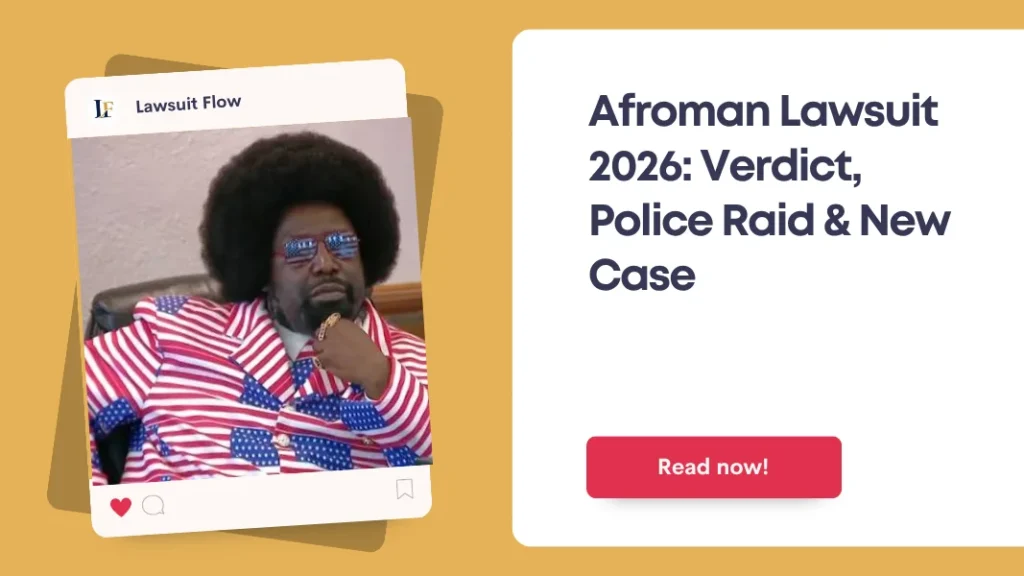
Rapper Afroman, whose legal name is Joseph Edgar Foreman, became involved in an unusual legal battle after Adams County, Ohio, law-enforcement officers searched his home in August 2022. The Afroman lawsuit later centered on videos, songs, social-media posts, and merchandise he created using footage captured during that raid.
Search interest has focused on why police entered his home, why seven officers later sued him, whether a settlement or payout occurred, and what happened when the dispute finally reached a jury in March 2026.
The original officers’ lawsuit has now produced a verdict, but the broader legal story is not over. In July 2026, Foreman filed a separate lawsuit against former Adams County Sgt. Brian Newland, creating a new dispute arising from the same sequence of events.

What Is the Afroman Lawsuit?
The term “Afroman lawsuit” primarily refers to Cooley v. Foreman, an Ohio civil case filed by seven members of the Adams County Sheriff’s Office against Joseph Foreman in March 2023.
The dispute began after officers executed a search warrant at Foreman’s Ohio residence in August 2022. Security cameras captured the search, including officers entering and searching the property. Foreman later incorporated portions of that footage into music videos and online posts criticizing and mocking the raid.
The officers alleged that Foreman’s content harmed them through claims including defamation, false-light publicity, invasion of privacy, and unauthorized commercial use of their personas. Some claims were dismissed before trial.
The remaining dispute eventually reached a jury in March 2026. The jury found in Foreman’s favor, meaning the officers did not obtain damages from him.
Afroman Lawsuit Update 2026
The biggest 2026 development came on March 18, when an Adams County jury rejected the officers’ remaining claims against Foreman. Reports from the trial state that the plaintiffs had requested a combined award of approximately $3.9 million. The jury instead found for Foreman.
The legal story then changed direction.
On July 27, 2026, Foreman filed Foreman v. Newland in Adams County Common Pleas Court against Brian K. Newland, one of the former plaintiffs and an officer involved in the original events. The new complaint includes claims for malicious prosecution, abuse of process, intentional infliction of emotional distress, and tortious interference with contract.
As of October 2026, that newer case should not be confused with Foreman’s victory in the earlier lawsuit. It is a separate civil action, and its allegations have not yet been established by a final judgment.
What Is the Current Status of the Afroman Lawsuit?
The original Cooley v. Foreman lawsuit has effectively concluded in Afroman’s favor at the trial-court level. The jury rejected the claims presented against him, and the court entered judgment for the defense.
There was therefore no multimillion-dollar damages award against Foreman in that case.
A separate lawsuit, Foreman v. Newland, was filed in July 2026. That proceeding concerns Foreman’s allegations against Brian Newland arising partly from the earlier litigation.
Readers should distinguish these two cases: Afroman was the defendant in the first major case and prevailed at trial; he is the plaintiff in the newer action.
Who Is Afroman?
Afroman is the stage name of Joseph Edgar Foreman, an American rapper widely known for songs such as “Because I Got High” and “Crazy Rap,” often referred to by listeners as “Colt 45.”
His legal dispute attracted national attention because it combined a police search, home-surveillance footage, music, satire, social-media commentary, defamation law, privacy claims, and First Amendment arguments.
Rather than keeping the 2022 raid private, Foreman turned the event into creative material. That decision became central to the officers’ later lawsuit and ultimately to the free-speech arguments presented in his defense.
Why Was Afroman Raided?
Adams County law enforcement searched Afroman’s Ohio property as part of an investigation involving suspicions of drug activity and kidnapping.
The warrant authorized officers to search for evidence connected to the investigation. However, prosecutors ultimately did not bring criminal charges against Foreman following the search.
That distinction matters. The issuance of a search warrant does not itself establish that the person whose property is searched committed a crime.
When Did Police Raid Afroman’s Home?
The search took place on August 21, 2022, at Foreman’s residence in Adams County, Ohio.
Foreman was not ultimately criminally charged as a result of the raid. Footage from his home-surveillance cameras later became the raw material for several videos and social-media posts that triggered the subsequent civil dispute.
Why Did Adams County Deputies Obtain a Search Warrant?
The search warrant related to an investigation involving suspected drug possession or trafficking and kidnapping.
Law enforcement believed evidence relevant to those suspected offenses could be located at Foreman’s property.
A judge’s authorization of a search warrant is based on a probable-cause standard. It is not equivalent to a conviction or even a criminal charge, and Foreman ultimately faced neither from the search.
What Were Deputies Searching For?
The warrant reportedly authorized a search for marijuana, other drugs or drug-related evidence, and evidence associated with the underlying trafficking and kidnapping investigation.
Officers therefore searched multiple areas of the residence and Foreman’s belongings.
The subsequent absence of criminal charges became an important part of Foreman’s public criticism of the raid.
What Did Police Find During the Raid?
Reports indicated that officers seized marijuana and cash, but prosecutors said the search did not produce probative criminal evidence sufficient to lead to charges against Foreman.
More than $5,000 in cash was taken during the search. Foreman maintained that the money came from his music work and performances.
When the money was later returned, a $400 discrepancy became another point of controversy.
Was Afroman Arrested or Charged After the Raid?
No. Afroman was not criminally charged as a result of the August 2022 search.
That fact became central to his criticism of law enforcement. He argued publicly that his home had been damaged and searched in connection with serious suspicions even though the investigation did not ultimately produce criminal charges against him.
What Happened During the Afroman Police Raid?
Officers entered Foreman’s property while executing the search warrant and searched his residence for evidence.
Home-security cameras recorded portions of the operation. The footage showed armed officers moving through the property, searching belongings, and entering areas of the home.
Foreman later used those recordings to criticize the search publicly. His songs and videos transformed what might otherwise have remained a local law-enforcement dispute into a nationally discussed First Amendment and defamation case.
Why Was Afroman’s Front Door Broken?
Law-enforcement officers forcibly entered the residence while executing the search warrant.
Footage of the operation showed the entry and subsequent search. Damage to the property became part of Foreman’s public criticism and inspired the title and theme of “Will You Help Me Repair My Door.”
Foreman later pursued counterclaims concerning trespass and property damage, but those claims were dismissed before the 2026 trial after the court found the relevant conduct privileged as part of executing a lawful warrant.
What Property Was Seized During the Search?
Among the property taken during the search was cash totaling approximately $5,000.
Authorities initially treated the money as potentially connected to suspected drug activity, while Foreman said it represented legitimate earnings from his music career.
Because the investigation did not result in charges, the money was eventually returned. The amount returned, however, became controversial.
What Happened to the Cash Seized From Afroman’s Home?
Authorities recorded approximately $5,031 as having been seized from Foreman’s residence.
When the cash was returned in November 2022, repeated counts showed that the amount was $400 short of the recorded figure.
The discrepancy led to an outside review. A subsequent investigation attributed the problem to a counting error during the original evidence process rather than concluding that deputies had stolen the money.
Why Does Afroman Say $400 Was Missing?
Foreman maintains that $400 disappeared from the cash taken from his home.
The discrepancy itself was real in the sense that the amount returned was $400 below the originally recorded seizure total. Foreman publicly alleged that someone had taken the money.
However, an outside investigation reached a different conclusion. It attributed the discrepancy to a miscount during the raid. Accordingly, claims that an officer “stole” the $400 should be presented as Foreman’s allegation, not as an established finding.
How Did Security Camera Footage Lead to the Afroman Lawsuit?
Foreman’s surveillance system recorded officers performing the search on his property. Those recordings later became central to his creative response.
He incorporated the footage into music videos, social-media posts, commentary, and other material criticizing the officers.
Seven officers shown in or connected to that content sued him. They argued, among other things, that their images and identities had been used without authorization and that Foreman’s statements subjected them to humiliation, ridicule and reputational harm.
Foreman countered that he had a constitutional right to criticize government officials and to use footage captured by cameras on his own property to discuss what happened there.
Why Did Afroman Release Videos of the Police Raid?
Foreman said the raid damaged his property and affected his life despite not resulting in criminal charges.
Music became his way of responding publicly.
Rather than releasing only raw surveillance footage, he incorporated the recordings into songs and satirical videos. The content mocked aspects of the search and questioned the officers’ conduct.
That creative response attracted millions of views but also triggered the civil claims brought by officers appearing in the footage.
Afroman Lemon Pound Cake Lawsuit Explained
“Lemon Pound Cake” became the best-known piece of content connected to the dispute.
The video used security footage showing an officer apparently looking at a cake while searching Foreman’s home. Foreman turned the moment into satire, combining footage of the police operation with music and commentary.
The officers argued that Foreman went beyond simply documenting the raid. Their lawsuit challenged his use of their images and certain statements made about them.
The resulting case therefore was not literally a lawsuit about cake. “Lemon Pound Cake lawsuit” became shorthand for the broader legal fight over Foreman’s post-raid content.
What Is the Lemon Pound Cake Video?
“Lemon Pound Cake” is a music video created by Afroman using surveillance footage from the police search.
Its title references a moment in which an officer was recorded near or looking at a lemon pound cake inside the residence.
Foreman used the scene humorously while criticizing the overall search.
Why Was Lemon Pound Cake Part of the Lawsuit?
The video displayed officers involved in the search and helped spread footage of the raid to a much larger audience.
Plaintiffs argued that Foreman’s use of their images, combined with his commentary and related posts, caused humiliation, ridicule, emotional distress and reputational damage.
The video therefore became important evidence in evaluating both what Foreman communicated and how the officers were depicted.
How Did Afroman Use Police Raid Footage?
Foreman incorporated surveillance recordings into music videos and distributed related material through social-media platforms.
He also created posts and merchandise referring to officers involved in the search.
The officers initially argued that this amounted to unauthorized commercial exploitation of their personas, among other claims. The court later dismissed the misappropriation-related claims before trial.
Why Did the Officers Object to the Video?
The plaintiffs argued that the content exposed them to ridicule, harassment and reputational harm.
Their objections were not limited to the fact that Foreman showed footage of the raid. They also challenged statements, jokes and characterizations accompanying the footage.
Foreman maintained that his content was criticism and artistic expression concerning government officials performing official duties.
Afroman “Will You Help Me Repair My Door” Explained
“Will You Help Me Repair My Door” was another song created after the raid.
Its title refers directly to the physical damage Foreman said occurred when officers entered his residence.
Like “Lemon Pound Cake,” the video helped turn the police operation into a public controversy and became part of the broader body of content challenged by the officers.
Why Did Afroman Write the Song?
Foreman presented the song as a response to the damage and disruption caused by the raid.
The central idea was straightforward: officers entered and damaged his property during an investigation that ultimately did not result in charges, so he used music to question what had happened.
The song combined humor with criticism of law enforcement.
How Was Police Raid Footage Used in the Video?
Security-camera recordings were incorporated into the video to visually document the search.
Instead of reenacting the incident, Foreman could show viewers actual footage captured at his residence.
That distinction became important to his broader defense that he was commenting on a real government action occurring on his own property.
Was the Song Part of the Officers’ Lawsuit?
Yes. Foreman’s post-raid music videos and related online material formed the factual basis of the officers’ civil case.
The plaintiffs challenged both the use of their appearances and statements Foreman made in connection with the videos and social-media content.
Why Did Police Officers Sue Afroman?
Seven Adams County law-enforcement officers sued Foreman after he publicly distributed content using footage of the raid and made statements criticizing or mocking them.
They alleged that the material caused humiliation, emotional distress, ridicule and reputational damage. They also initially challenged his commercial use of their likenesses.
The case raised an unusual conflict between personal reputation and privacy interests on one side and artistic expression and criticism of public officials on the other.
Ultimately, the jury rejected the claims that reached trial.
Cooley v. Foreman Explained
Cooley v. Foreman, case number CVH20230069, was filed in the Adams County Court of Common Pleas.
The case was named for plaintiff Shawn Cooley and defendant Joseph Edgar Foreman.
It proceeded through motions, discovery and pretrial rulings for approximately three years before reaching a jury in March 2026.
The jury found for Foreman on the claims presented at trial.
Who Filed the Lawsuit Against Afroman?
Seven law-enforcement officers were named as plaintiffs:
- Shawn D. Cooley
- Justin Cooley
- Michael D. Estep
- Shawn S. Grooms
- Brian Newland
- Lisa Phillips
- Randolph L. Walters Jr.
The original complaint identified them as members of the Adams County Sheriff’s Office in various deputy, sergeant and detective-sergeant roles.
When Was the Lawsuit Filed?
The complaint was filed on March 13, 2023, in Adams County Common Pleas Court.
The dispute then continued through extensive pretrial proceedings before reaching trial almost exactly three years later in March 2026.
How Many Officers Sued Afroman?
Seven officers sued Afroman.
They were individuals whose images, identities or conduct appeared in or were discussed through Foreman’s post-raid videos and online commentary.
What Damages Did the Officers Seek?
By the 2026 trial, attorneys for the plaintiffs sought a combined award of approximately $3.9 million.
The requested amount represented claimed harm associated with Foreman’s statements and content.
A requested damages figure is not the same as money legally owed. The jury ultimately rejected the officers’ claims and did not award them the requested damages.
What Claims Did the Officers Bring Against Afroman?
The litigation involved several theories of liability over time, including claims concerning defamation, false light, privacy, and commercial use of the officers’ identities.
Not every claim survived until trial.
In October 2023, the court partially granted Foreman’s motion to dismiss. Claims based on unauthorized commercial use or misappropriation of the officers’ personas were dismissed, while other claims—including defamation and false-light theories—continued.
Defamation
Defamation generally involves a false statement of fact communicated to others that legally harms a person’s reputation.
The officers alleged that Foreman made false and damaging statements about them in his videos and online posts.
Because the statements involved law-enforcement personnel and conduct during an official search, constitutional protections for criticism of public officials became particularly important.
False Light
False-light claims concern publicity that allegedly presents someone to the public in a materially false and highly offensive manner.
The officers argued that Foreman’s content portrayed them unfairly or falsely.
At trial, however, the jury did not find Foreman liable on the claims submitted for decision.
Invasion of Privacy
Privacy allegations arose partly from Foreman’s publication of footage showing officers during the search.
The unusual context mattered: the recordings were made by surveillance cameras at Foreman’s residence while government officers were executing official duties.
The dispute therefore raised questions about how traditional privacy principles apply when public officials are recorded performing government functions.
Emotional Distress
The plaintiffs described emotional and personal consequences allegedly resulting from Foreman’s content, including ridicule and harassment.
Such harm may be relevant to damages or particular tort theories, but experiencing distress alone does not automatically establish liability.
The plaintiffs still had to prove the legal elements of the claims presented to the jury.
Misappropriation of Likeness
The officers initially argued that Foreman improperly exploited their identities and appearances commercially through videos, posts and merchandise.
This theory did not survive intact.
The court dismissed the misappropriation or unauthorized-use-of-persona claims in 2023, an important pretrial victory for Foreman.
Why Did the Officers Claim Afroman Defamed Them?
The officers argued that certain statements Foreman made were not merely jokes, opinions or criticism but false assertions capable of damaging their reputations.
They pointed to social-media posts, songs, videos and other material that allegedly portrayed individual officers negatively.
Foreman’s defense emphasized context. His attorneys argued that reasonable viewers would understand much of the disputed material as satire, criticism or artistic expression rather than literal factual reporting.
That distinction was central because defamation law generally does not impose liability merely for offensive opinions, rhetorical exaggeration or protected criticism.
Did Afroman Make Money From the Police Raid Videos?
Foreman’s videos generated substantial public attention, and the officers argued that he commercially benefited from content connected to the raid.
He also used related imagery in merchandise and continued incorporating the dispute into his music and public persona.
That commercial dimension was one reason the plaintiffs initially pursued claims involving use of their personas.
However, earning money from expressive content does not automatically remove First Amendment protection. The court dismissed the officers’ persona-misappropriation claims before trial.
Did the Officers Seek Afroman’s Music and Merchandise Profits?
The officers’ case challenged Foreman’s alleged commercial use of their images and sought monetary relief connected to the content.
They argued that he should not be permitted to profit from unauthorized use of their likenesses.
Those theories faced a significant setback when the court dismissed claims concerning misappropriation and unauthorized use of persona.
By the 2026 trial, the dispute centered on the remaining claims rather than automatically giving officers a right to Foreman’s music or merchandise revenue.
What Claims Were Dismissed Before the Afroman Trial?
One of the most important pretrial rulings came in October 2023.
The court granted Foreman’s dismissal motion in part and rejected claims concerning misappropriation of likeness/unauthorized use of persona.
Other claims survived.
Separately, Foreman had brought counterclaims relating to the search itself. In February 2026, the court granted summary judgment against his trespass and property-damage counterclaims, finding that the conduct at issue occurred under the authority of a lawful search warrant.
Which Claims Went to Trial?
The surviving case focused primarily on claims involving defamation and false-light publicity, along with remaining privacy-related issues reflected in the litigation.
The central question was whether Foreman crossed the legal line between constitutionally protected criticism and actionable false statements or portrayals.
The jury ultimately ruled for Foreman across the claims it was asked to decide.
Afroman Court Trial 2026
The long-running civil dispute finally reached a jury in March 2026.
The proceedings attracted considerable media attention because the evidence included Afroman’s music, social-media content, police-surveillance footage and testimony from both Foreman and the officers.
The trial lasted only several days despite the case having been pending since 2023.
When Did the Afroman Trial Begin?
The trial began on March 16, 2026.
Foreman testified during the proceedings, defending his decision to create and distribute content about the search.
The jury returned its verdict on March 18.
Where Was the Trial Held?
The case was tried in Adams County, Ohio, where the underlying search occurred and where the original civil complaint had been filed.
The proceeding took place in the Adams County court system.
What Did the Officers Tell the Jury?
The officers described ridicule, unwanted attention, harassment and personal distress that they said followed Foreman’s viral posts and videos.
They argued that some of his statements went beyond criticism of the raid and falsely attacked them personally.
Their attorney asked the jury to compensate them for the alleged harm, ultimately seeking approximately $3.9 million collectively.
What Did Afroman Tell the Jury?
Foreman defended his videos as his response to what happened at his home.
He maintained that officers entered and damaged his property and that he was entitled to use recordings from his own security system to criticize them.
His position was essentially that the officers were attempting to make him financially responsible for his reaction to their own official conduct.
What Was Afroman’s First Amendment Defense?
Foreman’s defense relied heavily on the principle that the First Amendment protects criticism of government officials.
The ACLU had previously filed an amicus brief supporting his motion to dismiss, arguing that people have a strong constitutional right to criticize police conduct and other matters of public concern.
The defense also emphasized the difference between provably false factual assertions and satire, opinion, parody or rhetorical criticism.
Why Was Freedom of Speech Important in the Afroman Lawsuit?
The dispute involved more than whether individual officers disliked Foreman’s videos.
Police officers exercise governmental power. Speech concerning how they execute a search warrant therefore implicates public accountability and matters of public concern.
The First Amendment provides especially significant protection for criticism of government officials. That does not create unlimited immunity from defamation law, but it can raise the plaintiffs’ burden when they challenge speech about their official conduct.
The ACLU characterized the officers’ suit as threatening protected criticism of public officials. The jury ultimately found for Foreman.
Were the Officers Considered Public Officials?
Law-enforcement officers performing their official duties can fall within the public-official framework relevant to constitutional defamation law.
That status matters because public officials generally face a higher burden when seeking damages for defamatory statements connected to their official conduct.
The legal analysis does not mean every statement about an officer is automatically protected. Rather, constitutional standards may require additional proof before liability can be imposed.
What Is Actual Malice in a Defamation Case?
“Actual malice” has a specialized meaning in U.S. defamation law.
It does not simply mean anger, hostility or a desire to embarrass someone.
Under the constitutional standard associated with public-official defamation cases, actual malice generally requires proof that the defendant made a false factual statement while knowing it was false or acting with reckless disregard for whether it was true.
That demanding standard helps protect robust debate and criticism concerning government officials.
Afroman Lawsuit Verdict
The jury returned its verdict on March 18, 2026, after the three-day trial.
Foreman prevailed.
The jury rejected the officers’ claims and did not award them the millions of dollars requested by their attorney.
The result ended the central dispute in Cooley v. Foreman in Foreman’s favor and became a widely reported free-speech victory.
When Did the Jury Reach Its Verdict?
The jury reached its decision on March 18, 2026.
Reports indicate that deliberations lasted only a matter of hours before jurors returned a defense verdict.
Did the Jury Find Afroman Liable for Defamation?
No.
The jury did not find Foreman liable for defaming the officers on the claims presented at trial.
That finding meant the plaintiffs could not recover the defamation damages they had requested.
Did the Jury Find Afroman Liable for False Light?
No.
Reporting on the verdict states that jurors found for Foreman on the false-light claims as well.
The verdict therefore rejected the officers’ principal remaining theories of liability.
Did the Officers Receive Any Damages?
No damages were awarded to the officers based on the jury’s defense verdict.
Although their attorney requested approximately $3.9 million collectively, the jury did not impose that liability on Foreman.
Did Afroman Win the Lawsuit?
Yes. Afroman won the 2026 jury trial brought by the seven Adams County officers.
The jury ruled in his favor on the claims before it, meaning he was not ordered to pay the damages requested by the plaintiffs.
This result should not be confused with his separate July 2026 lawsuit against Brian Newland. Foreman’s status in that newer case is different: he is the plaintiff seeking relief rather than the defendant resisting the officers’ claims.
How Much Money Were the Officers Seeking From Afroman?
At trial, the officers collectively sought approximately $3.9 million in damages.
Earlier pleadings and individual damage theories varied, but the roughly $3.9 million figure was the amount reportedly requested from the jury during the 2026 trial.
The jury rejected the underlying claims, so the requested amount did not become a judgment against Afroman.
Did Afroman Have to Pay the Officers $3.9 Million?
No.
The $3.9 million figure represented damages the plaintiffs wanted the jury to award, not money Afroman had already been ordered to pay.
Because the jury found in Foreman’s favor, the officers did not receive that requested award.
This distinction is important because headlines mentioning a multimillion-dollar lawsuit can easily be mistaken for an actual payout or judgment.
Did the Officers Appeal the Afroman Verdict?
As of the current publicly reported 2026 status reviewed for this article, there is no confirmed appellate ruling reversing Afroman’s March 18 jury victory.
The trial-level result therefore remains the key outcome associated with Cooley v. Foreman.
Readers following future developments should distinguish between an appeal in that original case and Foreman v. Newland, which is a separate lawsuit initiated by Afroman.
Afroman Lawsuit 2026: Why Is He Now Suing a Former Deputy?
After defeating the officers’ lawsuit, Foreman switched from defendant to plaintiff.
On July 27, 2026, he sued former Adams County Sgt. Brian Newland in state court.
Foreman alleges that Newland’s participation in the earlier litigation was legally wrongful and caused him financial and emotional harm. Among other things, he says he incurred substantial attorney fees defending the officers’ case.
These are allegations in a newly filed civil complaint. They should not be treated as established facts unless and until they are admitted, proven or resolved through the court process.
Foreman v. Newland Explained
Foreman v. Newland is the newer civil lawsuit filed after Afroman’s March 2026 trial victory.
The case is identified as Foreman v. Newland, No. CVH20260287, in the Adams County Court of Common Pleas.
Unlike Cooley v. Foreman, Foreman is the plaintiff.
He alleges that Brian Newland improperly pursued the earlier litigation and seeks damages based on several Ohio civil-law theories.
When Did Afroman File the New Lawsuit?
Foreman filed the complaint on July 27, 2026.
That was approximately four months after the jury rejected the officers’ claims in the original case.
Who Is Brian Newland?
Brian K. Newland was an Adams County law-enforcement officer involved in the events surrounding the raid and was one of the seven plaintiffs who sued Foreman in the earlier litigation.
The original complaint identified Newland as a detective sergeant with the Adams County Sheriff’s Office at the relevant time.
Why Is Afroman Suing Brian Newland?
Foreman alleges that Newland wrongfully pursued the earlier lawsuit against him despite lacking an adequate legal or factual basis.
His complaint claims that defending that litigation caused attorney fees, emotional distress and other harm.
Newland’s liability has not been established merely because the complaint was filed. The allegations must still be tested through the judicial process.
How Is the New Lawsuit Connected to the Earlier Case?
The connection is direct.
Newland was one of the plaintiffs in the original case against Foreman. After that lawsuit ended with a jury verdict for Foreman, Foreman filed the new action alleging that Newland’s pursuit of the prior case itself created legal liability.
Thus, the second lawsuit grew out of the first litigation rather than directly replacing it.
What Does Afroman’s New Lawsuit Allege?
Foreman’s July 2026 complaint asserts several civil causes of action against Newland.
Reported claims include:
- malicious prosecution;
- abuse of process;
- intentional infliction of emotional distress; and
- tortious interference with contract.
Foreman alleges that the earlier lawsuit lacked proper legal justification and forced him to spend money defending himself.
Those assertions currently represent Foreman’s side of the dispute, not final judicial findings.
Malicious Prosecution
Malicious prosecution generally addresses the wrongful initiation or continuation of legal proceedings under circumstances defined by state law.
Foreman alleges that Newland pursued claims against him that lacked an adequate legal and evidentiary basis.
Whether he can establish every required element is a question for the court and potentially a future fact-finder.
Abuse of Process
Abuse of process generally concerns allegedly improper use of legal procedures for a purpose outside their legitimate function.
Foreman’s complaint invokes this theory in connection with the earlier litigation.
Again, filing the claim does not establish that abuse occurred. Newland is entitled to contest the allegations and raise applicable defenses.
Intentional Infliction of Emotional Distress
Foreman also alleges that Newland’s conduct caused severe emotional harm.
Intentional-infliction claims generally require more than ordinary disagreement, embarrassment or stress associated with litigation.
The precise requirements depend on applicable Ohio law and the facts the plaintiff can prove.
Tortious Interference With Contract
The new complaint also asserts tortious interference with contract.
This type of claim generally concerns intentional and improper interference with an existing contractual relationship.
Foreman will need to establish the relevant contract, alleged interference, causation and other required elements rather than relying solely on his victory in the earlier case.
What Does Afroman Allege About the Earlier Lawsuit?
Foreman characterizes Newland’s earlier claims as frivolous and alleges they were unsupported by existing law or sufficient evidence.
He says the case forced him to incur legal expenses and caused emotional harm.
Those allegations build on the fact that Foreman ultimately prevailed before the jury. However, losing a lawsuit does not by itself prove malicious prosecution or abuse of process.
The new court must evaluate the specific elements of Foreman’s claims independently.
How Much Is Afroman Seeking in the New Lawsuit?
Public reporting surrounding the July filing states that Foreman described himself as seeking approximately $1.5 million from Newland.
The ultimate amount recoverable, if any, will depend on the claims, evidence, procedural rulings and outcome of the case.
No $1.5 million award has been entered merely because Foreman requested damages.
What Is the Current Status of Foreman v. Newland?
As of the latest 2026 reporting reviewed here, Foreman v. Newland is a newly filed civil dispute in Adams County, Ohio.
The complaint was filed July 27, 2026.
There is no final judgment establishing Newland’s liability in the sources reviewed for this update. The case should therefore be described as pending rather than as another Afroman victory.
Has Afroman Won His New Lawsuit?
No confirmed final victory has been reported in Foreman v. Newland.
Afroman won the earlier lawsuit filed against him by seven officers, but his July 2026 case against Newland is separate.
Confusing those proceedings can create a misleading impression that a court has already awarded Foreman damages in his new case.
Has the Afroman Lawsuit Been Settled?
The original officers’ lawsuit did not end through a settlement.
It proceeded to trial, and the jury returned a verdict for Afroman on March 18, 2026.
Likewise, no confirmed settlement has been reported in the newer Foreman v. Newland dispute in the sources reviewed for this update.
Is There an Afroman Lawsuit Settlement Amount?
No settlement amount applies to the original case because the dispute ended with a jury verdict rather than a negotiated settlement.
The approximately $3.9 million figure associated with the case was the amount the officers sought at trial—not a settlement and not an amount Afroman paid.
Similarly, Foreman’s reported $1.5 million demand in his newer case should not be described as a settlement or payout.
Is the Afroman Lawsuit a Class Action?
No.
Neither the officers’ original lawsuit nor Foreman’s 2026 lawsuit against Newland is a consumer class action.
The original case involved seven specifically named law-enforcement plaintiffs pursuing their own claims against Foreman.
The newer case involves Foreman pursuing claims against Newland.
There is therefore no broader class of consumers or claimants represented in these proceedings.
Can Anyone File a Claim in the Afroman Lawsuit?
No.
There is no open compensation program for members of the public connected to these lawsuits.
Because the cases are individual civil disputes rather than class actions or mass-tort settlements, unrelated people cannot submit claims simply because they followed the controversy or viewed the videos.
Is There an Afroman Lawsuit Payout or Claim Form?
No public claim form or class-action payout program exists for the Afroman litigation described here.
Web searches for “Afroman lawsuit payout” may arise from confusion over the damages requested in court.
The officers sought millions from Foreman but lost at trial. Foreman later sought damages in his separate case against Newland, but a damages demand is not the same as an awarded payout.
Afroman Lawsuit Timeline
The dispute spans more than four years and involves two distinct lawsuits.
The key sequence is the 2022 search, Foreman’s musical response, the officers’ 2023 civil complaint, the 2026 jury verdict, and Foreman’s subsequent lawsuit against Newland.
August 2022: Police Raid Afroman’s Ohio Home
On August 21, 2022, Adams County law-enforcement officers executed a search warrant at Foreman’s residence.
Home-surveillance cameras captured portions of the operation.
2022: No Criminal Charges Filed Against Afroman
The investigation did not ultimately produce criminal charges against Foreman.
Cash taken during the search was later returned, although a $400 discrepancy led to a separate controversy and investigation.
December 2022: Afroman Releases Videos Using Raid Footage
Foreman incorporated footage from the search into music videos and online content.
Songs associated with the controversy included “Lemon Pound Cake” and “Will You Help Me Repair My Door.”
March 2023: Seven Officers Sue Afroman
Seven Adams County law-enforcement officers filed their civil complaint in March 2023.
They alleged various harms arising from Foreman’s videos, posts, statements and use of their appearances.
2023–2025: Lawsuit Moves Through Pretrial Proceedings
The case spent several years in motions, discovery and other pretrial proceedings.
The court dismissed the officers’ misappropriation-related claims while allowing other theories to continue. Foreman also pursued counterclaims, some of which were later dismissed.
March 2026: Afroman Defamation Trial Begins
Trial began on March 16, 2026.
The officers testified about the alleged effects of Foreman’s content, while Foreman defended his speech and explained his response to the raid.
March 18, 2026: Jury Rules in Afroman’s Favor
The jury rejected the officers’ remaining claims and found for Foreman.
The plaintiffs therefore did not receive the approximately $3.9 million requested from the jury.
July 27, 2026: Afroman Files Lawsuit Against Brian Newland
Foreman filed a new civil complaint against Brian Newland.
The suit alleges malicious prosecution, abuse of process, intentional infliction of emotional distress and tortious interference with contract.
2026: Foreman v. Newland Remains a Separate Legal Dispute
The new case should be treated independently from the concluded officers’ lawsuit.
Foreman’s March victory does not automatically establish Newland’s liability in the July case.
Afroman Net Worth and the Lawsuit
Online searches frequently connect Afroman’s net worth with the lawsuit because millions of dollars were requested in damages.
However, estimated celebrity net-worth figures are not reliable measures of a person’s actual assets and are not necessary to understand the legal outcome.
The important financial fact is that the officers’ multimillion-dollar request did not become a judgment against Foreman.
Did the Lawsuit Affect Afroman’s Finances?
Foreman has said the litigation cost him money, particularly through attorney fees and the broader consequences of defending a case for several years.
Those claimed losses are relevant to his newer lawsuit against Newland.
However, publicly available information does not provide a complete audited picture of how the litigation affected his overall finances.
Did Afroman Profit From Lemon Pound Cake?
The “Lemon Pound Cake” video generated substantial attention, and Foreman used the raid as material for music, social posts and merchandise.
The officers argued that he financially benefited from their appearances.
That does not establish a precise amount of profit attributable to the video, however. Public view counts or viral attention should not be treated as proof of net earnings.
Afroman Songs Connected to the Police Raid
Several pieces of Foreman’s music became intertwined with the legal dispute because they transformed footage and details from the raid into satire and commentary.
Two titles became particularly prominent.
Lemon Pound Cake
“Lemon Pound Cake” used surveillance footage from the search, including the now-famous scene involving an officer and cake inside Foreman’s home.
The song became a focal point of the officers’ complaints and one of the most recognizable elements of the entire controversy.
Will You Help Me Repair My Door
“Will You Help Me Repair My Door” focused more directly on property damage associated with officers entering Foreman’s residence.
The song reinforced Foreman’s broader argument that his music represented commentary on what government officers had done at his property.
How Did the Afroman Lawsuit Affect First Amendment Questions?
The lawsuit became notable because it tested the boundary between reputation-based tort claims and criticism of public officials.
The First Amendment does not make every statement immune from defamation law. Knowingly or recklessly false factual statements can still create liability when the necessary legal elements are proven.
But criticism, parody, opinion and artistic expression about government conduct receive substantial constitutional protection.
The ACLU argued that Foreman’s ability to criticize officers performing public duties implicated core First Amendment principles. The jury’s verdict ultimately left Foreman without liability on the claims presented.
What Could Happen Next in Afroman’s New Lawsuit?
Foreman v. Newland can proceed through several ordinary civil-litigation stages.
Newland may challenge the complaint through motions, dispute Foreman’s factual allegations, conduct discovery, seek summary judgment or ultimately proceed toward trial if the case survives pretrial proceedings.
A settlement is also theoretically possible, as in most civil litigation, but possibility should not be confused with evidence that settlement negotiations are occurring.
The critical point is that Afroman’s victory in Cooley v. Foreman does not guarantee victory in Foreman v. Newland. The newer claims have their own legal elements and evidentiary requirements.
Read: Tampax Lawsuit
Read: Slip and Fall Lawsuit
Read: Hello Toothpaste Lawsuit
Read: Turbo Tax Class Action Lawsuit
Read: Hernia Mesh Lawsuit Update
Read: Pruvit Lawsuit 2026
Read: Mrs. Meyers Lawsuit
Frequently Asked Questions
Why Was Afroman Raided?
Police searched Afroman’s Ohio home in August 2022 while investigating suspected drug activity and kidnapping. The search ultimately did not result in criminal charges against him.
Why Did Police Officers Sue Afroman?
Seven officers alleged that his videos, posts and statements using raid footage defamed them, portrayed them falsely and caused humiliation and reputational harm.
Did Afroman Win the Lawsuit?
Yes. On March 18, 2026, the jury found in Afroman’s favor on the officers’ claims presented at trial, resulting in no damages award against him.
How Much Money Did the Officers Seek From Afroman?
The officers reportedly asked the jury for approximately $3.9 million collectively. Afroman did not have to pay that amount because the jury ruled for him.
Why Is Afroman Suing a Former Deputy in 2026?
Afroman alleges Brian Newland wrongfully pursued the earlier case, causing legal expenses and other harm. Newland’s liability in the new lawsuit has not been established.
Final Thoughts
The Afroman lawsuit developed from an unusual chain of events: an August 2022 police raid, no resulting criminal charges, viral surveillance footage, satirical music videos, and a civil case brought by seven officers who appeared in or were discussed through Foreman’s content.
That original dispute now has a clear trial outcome. On March 18, 2026, the jury found in Afroman’s favor, and the officers did not receive the approximately $3.9 million they sought.
The story is not completely finished. Afroman filed Foreman v. Newland on July 27, 2026, seeking damages from former Sgt. Brian Newland under several civil theories. Those claims remain allegations unless established through settlement, admission or court judgment. Readers should therefore separate Afroman’s confirmed victory in the first case from the unresolved status of his newer lawsuit.