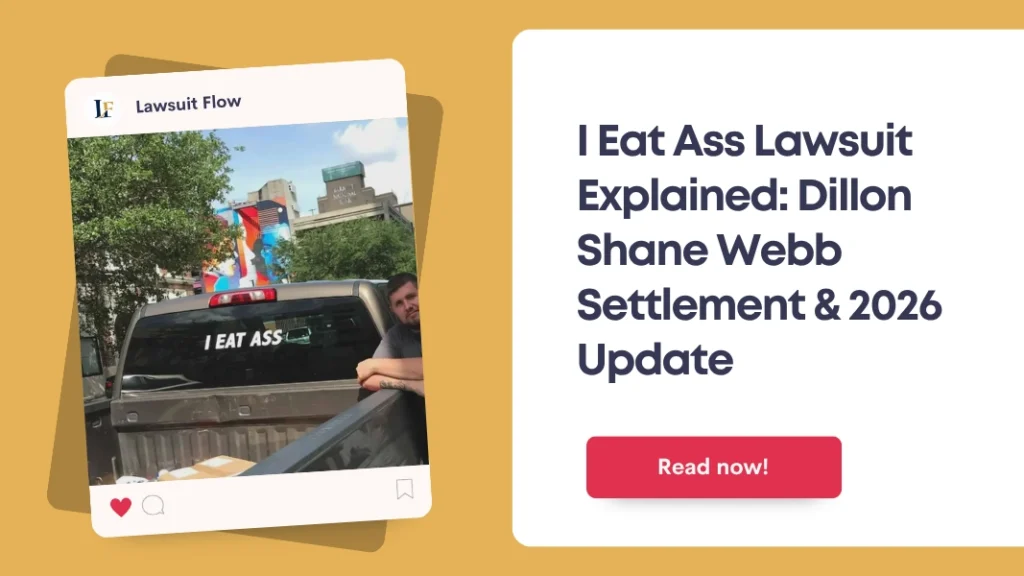

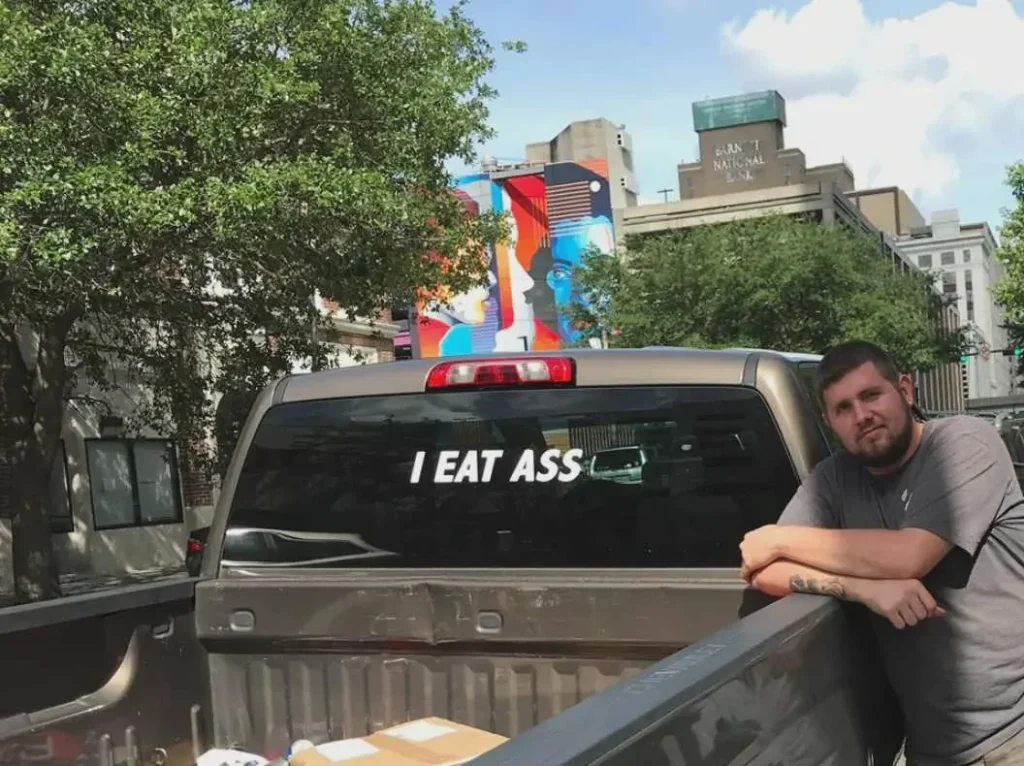
The I Eat Ass Lawsuit grew out of a 2019 traffic stop in Columbia County, Florida, involving Dillon Shane Webb and a large vulgar sticker displayed on the rear window of his pickup truck. What began as an obscenity citation became a closely watched dispute involving free speech, arrest powers, vehicle searches, and qualified immunity.
People still search the case for its lawsuit status, settlement amount, criminal charges, First Amendment issues, and claims involving the officers. Some online discussions also create confusion about a possible public payout or active settlement fund.
Court records provide a clearer picture. Webb’s criminal charges were dropped, he later filed a federal civil rights lawsuit, and the civil case ultimately ended without a public trial verdict. This article separates those events and explains what can actually be established as of 2026.
What Is the I Eat Ass Lawsuit?
The I Eat Ass Lawsuit refers to the federal civil rights case filed by Dillon Shane Webb after his May 5, 2019 arrest in Columbia County, Florida. Webb had a sticker on the rear glass of his vehicle displaying the phrase “I EAT ASS” in large letters.
Columbia County Sheriff’s Deputy Travis English stopped Webb because he believed the sticker violated Florida’s obscenity law. Webb was ultimately arrested after refusing to alter the sticker. The resulting criminal charges were later dropped after the State Attorney’s Office determined that Webb had a First Amendment defense.
Webb then sued English, Columbia County Sheriff Mark A. Hunter, and Chad Kirby in federal court. His lawsuit raised First Amendment and Fourth Amendment theories, along with government and supervisory liability claims.
The dispute is therefore more than a story about a vulgar bumper sticker. It became a constitutional case about when offensive expression may qualify as obscenity and when law enforcement officers can be held financially liable for actions taken during an arrest.
I Eat Ass Bumper Sticker Lawsuit: What Happened?
On May 5, 2019, Webb was driving in Columbia County with the sticker attached to the rear window of his vehicle. Deputy English noticed it while behind Webb at a traffic light and initiated a stop because he believed it violated Florida Statute 847.011.
English initially issued Webb a notice to appear. He then directed Webb to remove a letter from the sticker so the message would no longer display the same phrase. Webb refused and cited his First Amendment rights.
English contacted Corporal Chad Kirby. After discussing the obscenity statute and Webb’s refusal to alter the sticker, English arrested Webb and had the truck towed. A subsequent search of the truck found no contraband.
The criminal prosecution did not proceed. Webb later turned the encounter into a federal civil rights action, challenging different parts of the stop, arrest, search, and detention.
Who Is Dillon Shane Webb?
Dillon Shane Webb was the Florida motorist at the center of the 2019 incident. He was 23 at the time of the arrest and became nationally known after news outlets reported on the unusual dispute surrounding his vehicle sticker.
Webb’s importance to the legal story comes from his decision to challenge the officers’ actions. After prosecutors dropped the criminal case, he filed a federal lawsuit on August 21, 2019.
His lawsuit eventually included eight counts covering First Amendment retaliation, an allegedly unlawful traffic stop, search and arrest, other Fourth Amendment issues, and theories of government or supervisory liability.
Why Was Dillon Shane Webb Arrested in Florida?
Webb was arrested after Deputy English concluded that the sticker could violate Florida’s law regulating obscene materials. The disagreement escalated after Webb refused the deputy’s direction to alter the sticker.
The arrest involved two alleged offenses: displaying obscene material on a vehicle and resisting an officer without violence. The second allegation arose from Webb’s refusal to alter the sticker after being directed to do so.
Those allegations should be distinguished from a conviction. Webb was not ultimately convicted on these charges. The State Attorney’s Office dropped them after concluding that a First Amendment defense applied.
The Traffic Stop in Columbia County
The stop occurred on May 5, 2019. English was behind Webb at a traffic light when he noticed the sticker and concluded that it might violate Florida Statute 847.011.
After stopping Webb, English eventually asked him to exit the vehicle and obtained consent for a pat-down. English then explained the reason for the stop and issued a notice to appear, which Webb signed.
The interaction changed course after the notice was issued. English directed Webb to modify the sticker by removing a letter.
Deputy Travis English’s Role in the Arrest
English was the deputy who initiated the traffic stop and made the arrest. Court records state that he believed the sticker constituted obscene material prohibited by Florida law.
After Webb refused to change the sticker, English contacted Corporal Kirby to discuss the statute, Webb’s refusal, and the possibility of arrest. English then arrested Webb and searched the vehicle.
His actions became a central focus of Webb’s later constitutional claims.
Why Webb Refused to Alter the Sticker
Webb refused because he maintained that displaying the message was protected expression under the First Amendment.
The dashcam evidence described by the federal court showed Webb specifically invoking free speech when English directed him to remove a letter from the sticker.
That refusal became legally significant because it contributed to the subsequent arrest while also forming part of Webb’s argument that law enforcement had retaliated against protected speech.
What Charges Were Filed Against Dillon Shane Webb?
Webb faced an obscenity-related charge connected to the sticker and a charge for resisting an officer without violence.
The charges arose from a single encounter, but they involved different legal theories. One concerned the content displayed on the vehicle. The other concerned Webb’s refusal to comply with the instruction to alter that content.
Neither charge resulted in a conviction. Prosecutors later dropped the case.
Obscene Writing on a Vehicle
The principal accusation was based on Florida Statute 847.011, which regulates obscene materials and specifically includes certain stickers, decals, emblems, or other devices attached to motor vehicles.
The current 2026 version of subsection (2) still includes vehicle stickers containing obscene descriptions, photographs, or depictions within its coverage. A first violation under that subsection can constitute a second-degree misdemeanor.
The legal dispute was therefore not about the existence of an obscenity statute. It centered on whether Webb’s particular sticker could constitutionally fall within it.
Resisting an Officer Without Violence
The second charge arose after Webb refused to alter the sticker.
Court records show that English and Kirby discussed if Webb’s refusal could constitute resisting without violence. They ultimately agreed that Webb should be arrested and his vehicle towed.
The charge did not establish that Webb had committed a crime. Like the obscenity allegation, it was later dropped.
Why Were the Criminal Charges Against Dillon Shane Webb Dropped?
The State Attorney’s Office for Florida’s Third Judicial Circuit concluded that Webb had a valid First Amendment defense and dropped the charges. That fact is expressly recorded in the later federal court proceedings.
This distinction is central to understanding the case. Prosecutors declining to pursue the criminal charges did not automatically establish civil liability against the officers who stopped or arrested Webb.
A later civil rights lawsuit applied different legal standards, including qualified immunity. Consequently, the dismissal of the criminal charges and the outcome of Webb’s federal civil claims cannot be treated as the same legal decision.
Florida Obscene Bumper Sticker Law Explained
Florida law does contain a statute that can reach obscene material displayed on a motor vehicle. Florida Statute 847.011 addresses numerous forms of obscene material, and subsection (2) expressly refers to stickers, decals, emblems, and similar devices attached to vehicles.
But the word “obscene” has a specialized constitutional meaning. Material is not automatically legally obscene simply because it contains profanity, vulgarity, or a sexual reference.
That distinction creates the central constitutional problem raised by cases involving offensive bumper stickers.
What Does Florida Statute 847.011 Say?
As of 2026, Florida Statute 847.011(2) prohibits knowing possession or control of specified obscene materials without an intent to distribute them. Its list expressly includes a sticker, decal, emblem, or other device attached to a motor vehicle containing obscene descriptions, photographs, or depictions.
A first violation under subsection (2), outside specified circumstances involving minors, is classified as a second-degree misdemeanor.
The statute’s reference to vehicle stickers does not eliminate constitutional protections. Any enforcement still has to operate within First Amendment limits governing obscenity and protected expression.
Vulgar Speech vs. Legally Obscene Speech
Vulgarity and constitutional obscenity are not interchangeable concepts.
A phrase can be crude, offensive, or sexual without necessarily falling outside First Amendment protection. The Supreme Court has long recognized that the government cannot criminalize expression simply because listeners find its wording offensive.
The distinction was particularly important in Webb’s case because prosecutors concluded that his First Amendment defense prevented the criminal prosecution from going forward.
Is the “I Eat Ass” Bumper Sticker Protected by the First Amendment?
The strongest simple answer is that offensive wording can receive First Amendment protection, but the constitutional analysis does not end merely because something is expressive.
Obscenity is a category of expression that can receive substantially less constitutional protection. The difficult issue in Webb’s case was therefore the classification of the sticker.
The criminal prosecutors treated Webb as having a valid First Amendment defense and dropped his charges. In the later civil litigation, however, the federal court addressed a different question: if the officers could be held personally liable under the standards governing qualified immunity.
Those separate proceedings explain why claims that the case conclusively established that every similar sticker is lawful are too broad.
I Eat Ass First Amendment Case Explained
Webb’s federal lawsuit alleged that the traffic stop and arrest implicated constitutional protections extending beyond the initial obscenity charge.
His operative complaint contained eight counts. They included First Amendment retaliation, unlawful Terry stop, unlawful search, unlawful arrest, deprivation of Fourth Amendment rights, and government or supervisory liability theories.
This made the federal litigation significantly broader than the original criminal case.
Webb’s Free Speech Claim
Webb argued that the officers’ actions violated his First Amendment rights.
The basic theory was that the government should not punish him for displaying constitutionally protected expression merely because an officer considered the wording offensive or inappropriate.
The later qualified-immunity analysis complicated that claim. The question was not simply if Webb possessed First Amendment rights, but if existing law made the alleged violation sufficiently clear for personal damages liability against the officer.
Webb’s Fourth Amendment Claim
Webb also challenged the lawfulness of the stop, search, arrest, and related conduct under the Fourth Amendment.
His complaint separately identified an unlawful Terry stop, unlawful search, unlawful arrest, and deprivation of Fourth Amendment rights.
Those claims mattered because a civil rights plaintiff can raise constitutional injuries independent of the underlying speech issue. A court can therefore reach different conclusions on First Amendment and Fourth Amendment theories arising from the same police encounter.
Search and Towing of Webb’s Truck
After arresting Webb, English searched his truck. The search did not uncover contraband.
The truck was then towed. Court records state that Webb’s mother, Kirby, and the tow-truck driver later arranged its release for approximately $225. Webb also incurred bail and jail-related costs following the arrest.
These events formed part of the factual basis for Webb’s damages and Fourth Amendment theories.
Webb v. English Lawsuit Explained
The federal case was Webb v. English, No. 3:19-cv-975-MMH-JBT, in the U.S. District Court for the Middle District of Florida, Jacksonville Division.
Webb filed the action on August 21, 2019. By the summary-judgment stage, the defendants were Travis M. English, Sheriff Mark A. Hunter, and Chad Kirby.
Both sides sought summary judgment. Webb sought judgment on liability and a trial concerning damages, while the defendants sought judgment in their favor.
Who Did Dillon Shane Webb Sue?
The September 2021 federal order identifies three defendants:
- Deputy Travis M. English
- Columbia County Sheriff Mark A. Hunter
- Corporal Chad Kirby
Webb’s claims addressed both individual conduct and theories involving government or supervisory responsibility.
The defendants did not all occupy the same role during the traffic stop, so the legal theories against them differed.
What Did the Civil Rights Lawsuit Allege?
Webb’s second amended complaint contained eight counts built around three broader constitutional theories.
They concerned alleged First Amendment retaliation, alleged Fourth Amendment violations, and government or supervisory liability. The Fourth Amendment counts addressed the traffic stop, search, arrest, and related constitutional deprivation.
These were civil allegations seeking legal relief. They should not be described as findings that every defendant violated Webb’s constitutional rights.
What Damages Did Webb Seek?
Webb sought damages arising from the arrest and related events.
The federal record describes financial expenses including roughly $225 connected with retrieving the truck, $250 paid to a bail bondsman, and a $15 jail fee. Webb also testified to emotional distress and embarrassment.
His summary-judgment motion asked the court to determine liability and set the matter for a damages trial. That requested relief should not be confused with money actually awarded by a jury or court.
What Is Qualified Immunity?
Qualified immunity is a doctrine applied in federal civil rights litigation involving government officials.
In simplified terms, an official performing discretionary governmental duties may be protected from personal damages liability unless the plaintiff can establish a violation of a constitutional right that was clearly established at the relevant time.
The “clearly established” component can make these cases difficult. A plaintiff may argue that an officer’s conduct violated the Constitution, yet still face qualified immunity if existing precedent did not give sufficiently clear notice that the particular conduct was unlawful.
Qualified immunity therefore concerns civil liability. It does not itself determine if criminal charges against the plaintiff were valid.
How Did Qualified Immunity Affect Webb v. English?
Qualified immunity became a major issue in Webb’s federal action.
The September 2021 proceedings produced a more complicated result than the simplified claim that Webb either completely “won” or completely “lost.” Some theories did not survive in the form he pursued them, while the case still had unresolved issues before its eventual resolution.
That procedural history is why the criminal dismissal, summary-judgment ruling, and later termination of the civil action should be discussed separately.
Why the First Amendment Claim Was Dismissed
The court’s qualified-immunity analysis protected English from damages on Webb’s First Amendment theory.
The problem for Webb was the clearly established law requirement. The existence of Florida’s obscenity statute and the specific circumstances surrounding the sticker affected the court’s analysis of what a reasonable officer could have understood at the time.
This did not reinstate Webb’s criminal charges or establish that the sticker was definitively illegal. The State Attorney had already dropped the criminal prosecution on First Amendment grounds.
Why the Fourth Amendment Claim Continued
The Fourth Amendment portion of the case required separate analysis because Webb challenged several distinct police actions.
His complaint included allegations concerning the stop, vehicle search, arrest, and other Fourth Amendment deprivations.
The federal litigation therefore did not become irrelevant simply because qualified immunity defeated the First Amendment damages theory. Remaining constitutional issues kept the dispute alive until the parties resolved the case.
Did Dillon Shane Webb Win the Lawsuit?
Not in the simple sense of receiving a public jury verdict declaring him the winner.
Webb did achieve an important result before filing the civil case: prosecutors dropped the criminal charges. In federal court, however, the litigation produced mixed procedural results, including qualified-immunity rulings unfavorable to parts of his case.
The civil action ultimately ended without a public trial verdict establishing a damages award. Publicly available information indicates that the parties resolved the remaining dispute and dismissed the case in 2021.
Calling that an outright court victory would therefore overstate what happened.
Dillon Shane Webb Settlement: How Did the Case End?
The federal lawsuit ended in late 2021 after the parties resolved the remaining dispute.
Available reporting based on the case record places the resolution in November 2021, followed by dismissal of the claims. The terms were not publicly disclosed in the sources available for review.
That means two facts should remain separate: the lawsuit ended after a resolution between the parties, but there is no publicly established damages figure that can responsibly be presented as Webb’s settlement payment.
There was also no public trial verdict awarding Webb a specified sum.
I Eat Ass Lawsuit Settlement Update 2026
As of September 2026, the underlying Webb litigation is not an active new lawsuit seeking public claimants.
The civil dispute dates to 2019 and ended in 2021. There is no indication in the reviewed record of an active class action, settlement administrator, public compensation program, or 2026 claim deadline connected to Webb’s case.
| Question | 2026 Status |
|---|---|
| Criminal charges | Dropped |
| Federal civil lawsuit | Ended |
| Public trial verdict | No |
| Settlement amount publicly disclosed | No confirmed figure |
| Public claim form | None identified |
| Class action | No |
| Public payout eligibility | No |
The continued use of “2026 update” in searches reflects renewed online interest rather than a newly filed 2026 case.
What Is the Dillon Shane Webb Settlement Amount?
There is no reliable public settlement amount that can be confirmed from the available court information and credible reporting.
Some websites and social posts may attach dollar figures to the case, but a number should not be treated as fact without a court filing, settlement document, government record, or reliable reporting establishing it.
The publicly documented expenses Webb incurred after his arrest are different from a settlement payment. Court records discuss costs such as towing, bail, and a jail fee, but those numbers do not reveal the amount of any later civil settlement.
Why Was the Settlement Amount Not Made Public?
Civil settlements can contain confidential financial terms even when the underlying lawsuit appears on a public federal docket.
If the parties file only a notice resolving the case or a stipulation of dismissal, the complete agreement may never become part of the publicly accessible court record.
That appears to be the practical issue here. Public sources establish the end of the lawsuit but do not provide a reliable monetary figure for the resolution.
Without a public agreement or another authoritative disclosure, assigning a dollar value would be speculation.
I Eat Ass Case Outcome 2026: Is the Lawsuit Still Active?
No. The original federal lawsuit is not an active 2026 case.
Webb filed the action in August 2019 following his May arrest. Major summary-judgment litigation occurred in 2021, and the dispute ended later that year.
Nothing in the reviewed material indicates that the original Webb v. English case has reopened as a new compensation proceeding in 2026.
Readers encountering new articles or social posts should therefore distinguish renewed online attention from new court activity.
Is There a Dillon Shane Webb Settlement Claim or Payout for the Public?
No public settlement claim program has been identified for this case.
Webb v. English was an individual civil rights lawsuit brought by Dillon Shane Webb. It was not a consumer class action in which thousands of people could submit claims for part of a common settlement fund.
A website suggesting that ordinary members of the public can receive money merely because they followed the case should be treated cautiously. A legitimate class settlement normally has identifiable court information, eligibility criteria, deadlines, and an authorized claims process.
Those features are not part of the Webb case.
What Happened to Deputy Travis English After the Lawsuit?
English remained the central individual defendant in Webb’s lawsuit because he conducted the traffic stop and arrest.
The federal litigation addressed his potential liability for the constitutional claims, and qualified immunity became important to the claims against him.
The reviewed public sources do not establish a specific post-case disciplinary action, firing, or other employment consequence that should be presented as a confirmed result of the lawsuit.
The legally documented outcome concerns the civil case itself. Claims about later employment consequences require separate official evidence.
What Happened to Sheriff Mark Hunter and Corporal Chad Kirby in the Case?
Sheriff Mark A. Hunter and Corporal Chad Kirby were also named defendants in the federal lawsuit.
Kirby’s involvement arose directly during the traffic stop. English called Kirby after Webb refused to alter the sticker. Court records state that the two discussed the obscenity statute, possible resisting charge, arrest, and towing of the vehicle.
Hunter’s involvement concerned the government and supervisory theories asserted by Webb rather than personally initiating the roadside encounter. Webb’s complaint included government entity liability, failure-to-train, and supervisor-liability counts.
Dillon Shane Webb Settlement Reddit Discussions
Reddit and other forums periodically revive the case because its unusual facts make it highly shareable.
Common discussion points include the arrest footage, constitutional protection for profanity, qualified immunity, the alleged settlement, and speculation about how much Webb might have received.
Those discussions can be useful for understanding public reaction, but they are not substitutes for court records. In particular, an unsupported settlement figure repeated in a Reddit comment does not become a confirmed payout amount.
The safest approach is to separate documented procedural events from speculation about private settlement terms.
Dillon Shane Webb GoFundMe: Was One Connected to the Case?
Yes. A GoFundMe was created in Webb’s name after the criminal charges were dropped.
Contemporary reporting said the fundraiser sought $15,000 to help with expenses connected to the incident, including bond, towing, missed work, and legal representation.
The fundraiser should not be confused with the later civil settlement. It was a crowdfunding effort seeking donations after Webb’s arrest.
It was also not a settlement claim form or court-administered compensation fund.
Can You Get Arrested for a Bumper Sticker?
Potentially, but the legal answer depends on what the sticker displays and the law being enforced.
A bumper sticker is a form of expression, and substantial First Amendment protections apply to speech displayed in public. Offensive language alone does not automatically remove those protections.
At the same time, constitutionally unprotected categories of expression can be regulated. Florida also maintains a statute specifically covering obscene material attached to vehicles.
The Webb case demonstrates why the distinction matters: an arrest can occur, but the legality of the arrest and the viability of the resulting criminal charge remain separate questions.
Are Vulgar Bumper Stickers Legal in Florida?
Vulgar bumper stickers are not automatically illegal merely because people find their wording offensive.
Florida Statute 847.011 targets obscene material, including certain material displayed through stickers and decals attached to vehicles.
Constitutional law places significant limits on how broadly “obscene” can be interpreted. A crude word or sexual reference therefore cannot automatically be treated as criminal obscenity.
Drivers should also remember that other laws may apply to vehicle displays in different circumstances. The constitutional analysis depends on the content, applicable statute, and facts of an enforcement action.
First Amendment Bumper Sticker Cases
Bumper stickers sit at the intersection of private expression and public visibility.
Courts have repeatedly recognized broad protection for speech that people may consider rude, distasteful, or offensive. The government generally needs more than public discomfort with particular words to criminalize their display.
Obscenity remains a separate constitutional category, which is why disputes often focus on classification rather than simple offensiveness.
Cohen v. California and Offensive Speech
One of the most important cases is Cohen v. California, decided by the U.S. Supreme Court in 1971.
Paul Cohen was convicted after wearing a jacket bearing a profane anti-draft message inside a courthouse. The Supreme Court reversed his conviction, holding that the state could not criminalize the public display of the expletive merely on the basis of its offensiveness without a more particularized justification.
Cohen did not involve Webb or a vehicle sticker, but its treatment of offensive language remains highly relevant to modern free-speech disputes.
How Courts Distinguish Vulgarity From Obscenity
Courts do not treat every vulgar phrase as constitutionally obscene.
The Supreme Court’s obscenity doctrine imposes a considerably narrower legal standard than ordinary dictionary meanings of words such as indecent, offensive, or vulgar.
Cohen illustrates the difference. The Court specifically recognized that offensive public wording does not automatically become unprotected obscenity merely because its language is crude.
That distinction helps explain why prosecutors abandoned Webb’s criminal case even though Florida had an obscenity statute covering vehicle stickers.
Can Police Order You to Remove a Bumper Sticker?
Police can issue lawful orders when a display actually violates an enforceable law, but an officer’s personal objection to a message does not itself make removal constitutionally permissible.
In Webb’s encounter, English instructed him to remove a letter from his sticker. Webb refused and invoked the First Amendment.
A driver facing a similar dispute should avoid turning a legal disagreement into a physical confrontation. Constitutional challenges are normally handled through attorneys and courts after the encounter.
The lawfulness of any removal order will depend on the particular content, statute, jurisdiction, and circumstances.
Free Speech Rights for Vehicle Stickers and Decals
Vehicle stickers and decals can communicate political, religious, humorous, commercial, personal, or provocative messages.
That expressive function places many displays within First Amendment principles. Government restrictions based on a message’s content can therefore face serious constitutional scrutiny.
Protection is not unlimited. Obscenity and certain other narrowly defined categories of expression may be regulated, and neutral vehicle regulations can also apply.
The Webb dispute demonstrates the practical difficulty: officers may invoke an existing statute, while courts later have to determine how that statute interacts with constitutional protections.
Can You Sue After a Wrongful Arrest Over Protected Speech?
Yes, a person who believes government officials violated constitutional rights may have potential civil remedies.
One common vehicle is a lawsuit under 42 U.S.C. § 1983. The plaintiff still has to prove the elements of the constitutional claim and overcome defenses that apply to the particular defendants.
A dismissed criminal charge does not automatically guarantee success in a civil rights lawsuit.
Section 1983 Civil Rights Claims
Section 1983 permits lawsuits against persons acting under color of state law for certain violations of federal constitutional or statutory rights.
Police officers, local officials, and government entities can raise different defenses and liability rules.
A plaintiff therefore needs more than proof that an arrest occurred. The case must connect the defendant’s conduct to a legally actionable deprivation of federal rights.
First Amendment Claims
A First Amendment claim can arise when government officials allegedly punish or retaliate against someone for constitutionally protected expression.
The plaintiff generally needs to establish protected activity and the required connection between that expression and the challenged government action.
Qualified immunity can become a separate obstacle when damages are sought from an individual officer.
Fourth Amendment Claims
The Fourth Amendment protects against unreasonable searches and seizures.
Depending on the facts, a wrongful-arrest case can raise questions about reasonable suspicion, probable cause, vehicle searches, detention, and arrest.
Webb’s complaint illustrates this separation. His Fourth Amendment theories included the traffic stop, search, arrest, and other alleged constitutional deprivations rather than relying exclusively on his free-speech claim.
Evidence That Could Matter in a Wrongful Arrest Case
Evidence can determine if a constitutional claim survives.
Potentially relevant material includes:
- Body-camera or dashcam footage
- Police reports and citations
- Arrest and booking records
- Photographs or video of the disputed display
- Witness statements
- Towing, bail, medical, or other expense records
- Communications involving officers or supervisors
- Records showing lost income or other claimed damages
Webb’s case itself relied heavily on video, depositions, documents, and other evidence developed during federal litigation.
How to File a Civil Rights Lawsuit for Wrongful Arrest
A potential plaintiff should first preserve evidence and obtain the records connected with the encounter.
A civil rights attorney can then evaluate the facts, identify possible defendants, determine the constitutional theories involved, and review applicable deadlines. Section 1983 cases can involve complicated rules governing probable cause, municipal liability, qualified immunity, and damages.
The basic process may involve documenting the incident, requesting records, evaluating legal claims, preparing a federal or state complaint, serving defendants, and proceeding through discovery and motions.
Anyone considering litigation should obtain advice based on the specific jurisdiction and facts rather than relying on another person’s case as a template.
What the Dillon Shane Webb Case Means for Free Speech
The case demonstrates that offensive speech and legally obscene speech are not synonymous.
It also shows how criminal law and civil rights law can produce different procedural outcomes. Prosecutors dropped Webb’s criminal charges because they determined he had a First Amendment defense. His later damages lawsuit still faced qualified-immunity and other civil liability rules.
That difference is one of the most useful lessons from the case.
A decision not to prosecute does not automatically establish that an officer is personally liable for damages, just as qualified immunity for an officer does not necessarily mean the underlying expression was definitively unlawful.
Why the I Eat Ass Lawsuit Is Trending Again in 2026
The case has several features that make it easy to rediscover through social media: an unusual Florida arrest, dashcam footage, provocative wording, free-speech questions, and an undisclosed civil resolution.
New 2026 articles have also renewed searches for the Dillon Shane Webb settlement amount and case outcome. The renewed attention should not be mistaken for a new lawsuit.
The underlying arrest occurred in 2019, and the federal civil litigation ended years ago. As of September 2026, no credible evidence reviewed for this article establishes a new class action, public settlement fund, or new payout opportunity arising from the case.
Read: Facebook User Privacy Settlement
Read: Turbo Tax Lawsuit
Read: Dr Squatch Lawsuit
Read: Pima County Sheriff Lawsuit
Read: Exploring CNLawBlog
Read: Native Hair Loss Lawsuit
Read: BSA Lawsuit Settlement
Read: SheaMoisture Lawsuit
Frequently Asked Questions
Was Dillon Shane Webb arrested over the I Eat Ass sticker?
Yes. Webb was arrested in Florida in May 2019 after a traffic stop involving the sticker and his refusal to alter it.
Were the charges against Dillon Shane Webb dropped?
Yes. The State Attorney’s Office dropped the criminal charges after determining that Webb had a valid First Amendment defense.
Did Dillon Shane Webb file a lawsuit?
Yes. Webb filed a federal civil rights lawsuit in 2019 against Travis English, Mark A. Hunter, and Chad Kirby.
What was the Dillon Shane Webb settlement amount?
No reliable public figure has been established for the settlement. Claims assigning a specific payout should be treated cautiously without authoritative documentation.
Is the I Eat Ass Lawsuit still active in 2026?
No. The original federal civil case ended in 2021 and is not an active class action or public compensation case in 2026.
Can people file a Dillon Shane Webb settlement claim?
No public claims process has been identified. Webb’s case was an individual civil rights lawsuit, not a class action settlement for consumers.
Was there a GoFundMe for Dillon Shane Webb?
Yes. A fundraiser was created after his arrest to help cover expenses such as towing, bond, missed work, and legal costs.
Final Thoughts
The I Eat Ass Lawsuit began with a 2019 Florida traffic stop but developed into a more complicated constitutional dispute involving speech, arrest, search, qualified immunity, and government liability. The criminal charges against Dillon Shane Webb were dropped after prosecutors recognized a First Amendment defense, while his later federal civil case followed its own legal path.
The available record does not support claims of an active 2026 lawsuit, public class settlement, or claim form. The civil dispute ended in 2021, and no reliable public settlement amount has been established.
For similar incidents, the outcome depends on the exact expression, applicable statute, police conduct, available evidence, and controlling constitutional precedent. A viral case can illustrate those issues, but it cannot determine the result of a different person’s arrest or civil rights claim.