
Blind Frog Ranch has attracted attention for treasure hunting, underground caverns, unusual discoveries, and the Discovery series Mystery at Blind Frog Ranch. That visibility has also fueled searches about the Blind Frog Ranch Lawsuit, particularly claims involving ownership, excavation, environmental rules, and alleged disputes over the Utah property.
The difficulty is separating documented facts from entertainment reporting and repeated online claims. Readers commonly want to know whether a lawsuit was actually filed, whether excavation was challenged, whether a settlement exists, and what legal questions surround the ranch.
Public records confirm that Duane Ollinger was associated with a conditional-use permit request for a mining operation in Utah. However, several broader lawsuit narratives circulating online lack an easily verifiable case number or primary court filing. This article separates those issues carefully.
What Exactly Is Blind Frog Ranch?
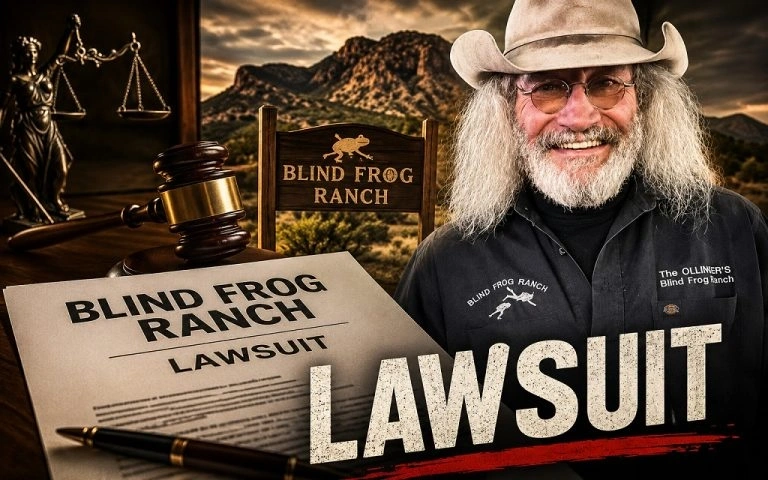
Blind Frog Ranch is a property in Utah’s Uintah Basin that became nationally recognizable through Mystery at Blind Frog Ranch. Discovery has presented the property as the site of Duane Ollinger’s search for alleged buried treasure and a network of underground caverns.
The ranch’s unusual reputation is central to the television series. Treasure theories, underground exploration, alleged paranormal events, trespassers, geological discoveries, and potentially valuable artifacts have all contributed to its public profile.
Those television storylines should not automatically be treated as evidence of a legal dispute. What appears dramatically on a reality program and what can be established through land records, regulatory documents, or court filings are separate questions.
Location and Size
Blind Frog Ranch is located in Utah’s Uintah Basin. Discovery described it as Duane Ollinger’s sprawling 160-acre property when promoting the second season of the program.
The remote setting matters because extensive digging, drilling, mining, or land alteration can raise regulatory questions even when conducted on privately owned property. Applicable requirements depend on the activity, land status, permits, environmental impacts, and relevant local, state, or federal rules.
The property’s location also contributes heavily to the program’s identity because the broader Uintah Basin has long been associated in popular culture with unusual phenomena and treasure stories.
Ownership of Blind Frog Ranch
Duane Ollinger was publicly identified by Discovery as the ranch’s owner and central investor. Discovery reported that the former high-risk oil contractor sold his company and invested heavily in the Utah mining opportunity.
There is, however, a documented detail that makes simplistic ownership narratives less useful. A 2009 Utah public notice listed Walter Duane Ollinger and Gale R. Tipton together as applicants seeking approval of a conditional-use permit for a mining operation on Deep Creek property.
That record establishes a connection between Ollinger, another named applicant, the property, and a mining-permit proceeding. It does not, by itself, prove the more expansive claims circulating online about later ownership litigation.
Popularity Through the TV Show
Mystery at Blind Frog Ranch transformed a remote Utah treasure hunt into a widely followed television story. Discovery’s coverage has featured Duane Ollinger, his son Chad, geologist Eric Drummond, security personnel, investigators, and other participants exploring the property.
The series began airing in 2021 and has continued well beyond its early seasons. Discovery currently lists Season 6 episodes, which is important when assessing online claims that litigation supposedly ended the production.
Television exposure also amplifies speculation. A property disagreement, permit issue, storyline, or cast change can quickly be described online as a “lawsuit” even when the underlying legal documentation is unclear.
Why Blind Frog Ranch Is Being Sued
This question requires an important qualification: a widely described, comprehensive lawsuit against Blind Frog Ranch has not been independently established through a readily identifiable public case number or docket in the sources reviewed for this article.
Several websites have reported allegations involving excavation, environmental concerns, property boundaries, mineral rights, neighboring landowners, and regulatory authorities. Some reports go further and describe injunctions or government involvement.
The evidentiary problem is that these details are frequently repeated from secondary sources rather than linked to an identifiable complaint, docket number, judicial order, or agency enforcement document. One investigation into the claims specifically reported that it could not locate the court case underlying the widely circulated environmental-lawsuit narrative.
What is documented is that Walter Duane Ollinger and Gale R. Tipton sought a conditional-use permit for a mining operation in Deep Creek, Utah, in 2009. That provides legitimate regulatory context, but a permit proceeding is not the same thing as a lawsuit.
For that reason, claims that Blind Frog Ranch “is being sued” should be presented as reported or alleged unless supported by a specific primary court record.
Disputes Over Ownership
Ownership is one of the most repeated themes in discussions surrounding Blind Frog Ranch. Online articles have interpreted land-record terminology and the involvement of additional parties as evidence that Duane Ollinger did not possess an unrestricted individual interest in every aspect of the property.
Legally, however, several different rights can exist in the same parcel. Surface ownership, mineral rights, easements, leases, access rights, co-ownership interests, and contractual rights are not necessarily held by one person.
That distinction becomes particularly important when valuable minerals or extensive excavation are involved. Someone may possess substantial rights in land while still being subject to another person’s property interest or government regulation.
The 2009 Utah notice provides verified evidence that Ollinger and Gale R. Tipton jointly appeared as applicants for a mining-operation permit. It does not establish the outcome of every later ownership claim or prove that a court ultimately found Ollinger lacked authority over the ranch.
Environmental and Excavation Concerns
Excavation is another major source of online discussion. The television program has shown drilling, underground exploration, heavy equipment, and other efforts to reach suspected treasure locations.
Private ownership does not automatically eliminate regulatory requirements. Depending on the operation, excavation can implicate zoning rules, mining permits, water protection, waste management, land disturbance, worker-safety requirements, or other regulations.
The strongest publicly verifiable regulatory fact is the earlier conditional-use permit request. Utah’s official public-notice record specifically states that Walter Duane Ollinger and Gale R. Tipton requested approval for a mining operation.
Claims that environmental organizations or government agencies later obtained injunctions against the ranch require separate evidence. Without the underlying complaint or order, those assertions should not be treated as established judicial findings.
Safety and Liability Concerns
Treasure exploration can involve substantial physical risks. Underground caverns, diving, drilling, unstable terrain, explosives, machinery, and confined spaces can create serious hazards.
From a legal perspective, an injury does not automatically prove negligence. Liability generally depends on facts such as who controlled the activity, what duty was owed, whether reasonable precautions were taken, whether a duty was breached, and whether that breach caused an injury.
Businesses may also face workplace-safety requirements, insurance obligations, premises-liability exposure, and contractual allocation of risk.
These are legitimate legal considerations for an operation like Blind Frog Ranch. They should not, however, be confused with proof that a particular safety lawsuit has been filed or successfully decided against the ranch.
The Importance of the Blind Frog Ranch Lawsuit Update
A reliable Blind Frog Ranch Lawsuit update matters largely because online accounts have become inconsistent. Some describe a major environmental case, others focus on ownership disputes, and still others blend unrelated criminal proceedings involving cast members into the ranch’s civil-law narrative.
As of August 2026, the safest conclusion from the available material is that regulatory and property questions have a factual foundation, but many detailed claims about a sweeping ranch lawsuit remain difficult to verify through primary court documentation.
There is also no verified public settlement program, consumer claim form, or class-action compensation process associated with the ranch dispute in the material reviewed.
Meanwhile, the television series itself clearly continued. Discovery lists Season 6 episodes in 2026, directly undermining claims that the program had already been permanently cancelled because of the alleged ranch litigation.
Readers should therefore distinguish three categories: documented public records, allegations reported by secondary websites, and fan speculation. Mixing those categories can make the legal situation appear far more certain than the evidence supports.
The Core Allegations in the Blind Frog Ranch Lawsuit
The allegations most frequently repeated in online coverage generally concern land ownership, excavation authority, environmental compliance, and regulatory oversight.
Reported claims commonly include:
- questions about who holds interests in the property;
- disputes involving boundaries or mineral rights;
- concerns about excavation and mining activities;
- allegations that additional permits or regulatory approvals were necessary;
- environmental concerns connected with extensive digging;
- questions about whether activities could affect neighboring or public land.
These themes are legally plausible in a mining or excavation context, but plausibility is not proof.
A genuine civil complaint normally identifies plaintiffs and defendants, a court, causes of action, factual allegations, requested relief, and a case number. A judicial ruling would provide further evidence of what a court actually decided.
Because those primary details have not been consistently produced alongside the most expansive Blind Frog Ranch claims, readers should avoid treating the allegations as adjudicated facts.
Timeline of the Blind Frog Ranch Lawsuits (2021–2025)
The timeline surrounding the alleged litigation is unusually difficult to reconstruct because television events, public records, and secondary online reports are frequently blended together.
| Period | What Can Be Said Carefully |
|---|---|
| 2021 | The show attracted growing attention and legal speculation began appearing around ranch storylines. |
| 2022 | Season 2 expanded public discussion about ownership, outsiders, and threats to the treasure hunt. |
| 2023–2024 | Online reporting increasingly described environmental and property disputes, often without primary docket citations. |
| 2025 | Lawsuit-update searches grew, while Season 5 demonstrated that production had continued. |
The distinction between when an allegation appeared online and when a legal action was actually filed is crucial. Those dates cannot safely be treated as interchangeable.
Blind Frog Ranch Lawsuit in 2021
The first season of Mystery at Blind Frog Ranch aired in 2021, bringing Duane Ollinger’s treasure operation to a much larger audience.
By December 2021, Discovery was promoting the second season and describing the ranch as Ollinger’s 160-acre property. Its official description focused on underground treasure, intruders, military helicopters, and a murder investigation as elements of the show’s mystery-driven narrative.
This period helped establish the environment from which later lawsuit speculation developed.
However, an on-screen dispute, threat, investigation, or statement that someone may pursue legal action should not automatically be interpreted as proof of a filed civil case. Verification requires the corresponding court record.
Blind Frog Ranch Lawsuit Developments in 2022
Season 2 aired beginning in January 2022, and legal questions became more prominent among viewers as the team’s activities expanded.
Online discussions increasingly focused on who actually controlled the ranch, whether outsiders could assert competing claims, and whether excavation could continue without interference.
Those questions overlap with genuine areas of property law. Co-ownership, mineral interests, boundary disagreements, and mining permits can all generate litigation.
Still, publicly accessible secondary reporting does not provide a sufficiently consistent case citation to treat every reported 2022 development as a verified court event. The appropriate distinction is between reported dispute developments and confirmed judicial proceedings.
Developments From 2023 to 2025
From 2023 through 2025, the alleged Blind Frog Ranch legal battle became a recurring subject across entertainment sites, legal blogs, social media, and fan communities.
Reports increasingly referenced environmental concerns, property interests, government oversight, and restrictions on excavation. Yet the underlying documentation remained difficult to trace.
One later review specifically found a genuine Utah government permit record but could not verify the widely repeated formal lawsuit through a case name, number, or docket citation.
At the same time, the show remained active. Discovery-related material confirms continued programming, and Season 5 aired in 2025. That makes claims that litigation had already forced a permanent shutdown inconsistent with the show’s documented continuation.
Real-Life Case Studies of the Blind Frog Ranch Disputes
The clearest real-world example is not a dramatic courtroom judgment but a government land-use record.
In November 2009, an official Utah public notice listed Walter Duane Ollinger & Gale R. Tipton as requesting approval of a conditional-use permit for a mining operation at property in Deep Creek, Utah. The notice also provided a specific property serial number.
That record illustrates an important legal principle: owning or controlling rural property does not necessarily mean every proposed commercial or mining activity can proceed without government approval.
A second useful case study is the show’s continuation despite litigation rumors. Discovery continued listing and airing the series through Season 6.
Together, these examples demonstrate why legal research requires precision. There is documentary support for mining-related regulatory activity, but that should not be expanded into claims about injunctions, damages, environmental liability, or court victories without corresponding evidence.
Why These Allegations Ring Out Beyond the Show
The Blind Frog Ranch story reaches beyond reality television because it touches several recurring legal issues affecting landowners, miners, investors, media companies, and entrepreneurs.
Property ownership is rarely as simple as “I bought the land, so I can do anything with it.” Zoning rules, mineral rights, environmental regulations, easements, neighboring property rights, and permitting requirements can limit how land is used.
Reality television adds another layer. Dramatic editing may compress events, emphasize conflict, or leave legal details unexplained. Viewers may therefore interpret an unresolved disagreement as a lawsuit or a regulatory issue as a court prohibition.
The ranch also demonstrates how quickly secondary reporting can become circular. Once one website publishes a detailed legal narrative, later websites may repeat it until an allegation begins to look independently confirmed.
For readers, publishers, and business owners, the broader lesson is straightforward: repeated reporting is not a substitute for primary evidence.
The Legal Landscape Behind the Blind Frog Ranch Lawsuit
Several bodies of law could potentially apply to activities conducted at a property such as Blind Frog Ranch.
Property law determines ownership interests, boundaries, easements, and certain access rights. Mineral law may determine who can legally extract resources beneath the surface.
Land-use and zoning rules can require government approval before mining or other intensive operations begin. The documented conditional-use permit request involving Ollinger demonstrates that land-use regulation was relevant to mining activity associated with the Deep Creek property.
Environmental law may become relevant if excavation affects protected resources, waterways, waste disposal, or regulated land. Workplace-safety and premises-liability principles can apply where employees, contractors, visitors, or production personnel face dangerous conditions.
None of these legal frameworks proves that a particular plaintiff successfully sued Blind Frog Ranch. They explain the regulatory environment in which a substantial excavation project operates.
That difference between potential legal exposure and an actual adjudicated claim is essential.
Key Legal Issues at Stake
Several legal questions would be important if a documented property or excavation case involving Blind Frog Ranch were litigated.
First is ownership and authority. A court could need to determine which parties possess relevant surface, mineral, access, or contractual rights.
Second is regulatory compliance. A property owner may need local or state authorization for mining, excavation, construction, water disturbance, or other activities.
Third is environmental responsibility. If land disturbance causes legally recognized environmental harm, regulators or affected parties may potentially pursue administrative or civil remedies.
Fourth is liability for injuries or property damage. Contractors, employees, neighboring owners, or visitors could potentially bring claims if the required elements of negligence or another cause of action were established.
Finally, any claimant would need evidence. Allegations alone do not determine liability. Courts examine documents, testimony, expert evidence, applicable statutes, property records, causation, defenses, and procedural requirements before imposing legal responsibility.
Why Did Eric Drummond Leave Blind Frog Ranch?
Eric Drummond appeared on Mystery at Blind Frog Ranch as a geologist and was prominently featured in Discovery’s Season 2 promotion.
Online searches sometimes connect changes in his appearances with the alleged legal disputes. There is no reliable public evidence reviewed here establishing that Drummond left because of the Blind Frog Ranch Lawsuit, an ownership fight, or an environmental case.
Cast participation can change for numerous reasons, including production decisions, scheduling, professional commitments, storyline changes, and personal choices.
Without a statement from Drummond, Discovery, or another authoritative source giving a specific legal explanation, claims that a lawsuit caused his departure remain speculative.
This is another area where viewers should distinguish between correlation and evidence. A cast member appearing less frequently during a period of legal rumors does not establish that the two events are connected.
Is Blind Frog Ranch Fake or Real?
Blind Frog Ranch is a real property, and the mining-related government record involving Walter Duane Ollinger provides independent documentary evidence connected to the Deep Creek location. Discovery also consistently identifies the Utah property as the setting of its series.
A different question is whether every event, interpretation, treasure theory, or paranormal claim presented on television should be taken literally.
Reality television is produced entertainment. Episodes are edited and structured into narratives. Viewers have debated the authenticity of discoveries and dramatic events, but skepticism from fans is not proof that the entire production is fraudulent.
There is no verified court ruling identified in the sources reviewed here declaring Mystery at Blind Frog Ranch legally fraudulent or “fake.”
The most accurate answer is therefore nuanced: the ranch and excavation project are real, while extraordinary claims presented or discussed on the program should be evaluated according to the evidence supporting each individual claim.
Was Blind Frog Ranch Cancelled?
No. Current information from Discovery shows that Mystery at Blind Frog Ranch continued into Season 6 in 2026. The network’s official page lists Season 6 episodes including The Book of Rhoades, The Mormon Mineshaft, Chamber of Gold, The Golden Staircase, The Giant’s Door, and Expelling the Curse.
Discovery also continued listing the program in its current shows schedule.
That is stronger evidence than speculation on fan pages or older articles predicting cancellation.
The series did experience major changes. Duane Ollinger died in June 2026 at age 68 after health problems, and reporting noted that other treasure hunters had taken a larger role in the sixth season.
Accordingly, changes to the cast or direction of the program should not be automatically attributed to an alleged lawsuit.
Consumer Rights and Legal Takeaways
Blind Frog Ranch is not a conventional consumer class-action matter, so typical questions about refunds, claim forms, settlement checks, or consumer compensation do not fit the available evidence.
There is currently no verified mass-settlement program identified here under which viewers or ordinary consumers can submit claims simply because they watched the program or followed the ranch.
The more useful legal takeaways concern evaluating legal information:
- Look for a case number before treating a lawsuit as confirmed.
- Distinguish complaints and allegations from court findings.
- Check government records when permits or regulators are mentioned.
- Do not assume private ownership eliminates land-use restrictions.
- Treat social-media and entertainment reports as secondary evidence.
- Verify settlement or compensation claims before submitting personal information.
These precautions are especially important when trending legal stories begin circulating across numerous websites using nearly identical claims.
Lessons for Entrepreneurs and Content Creators
The Blind Frog Ranch controversy provides useful lessons for entrepreneurs operating businesses that combine land, media, intellectual property, and potentially regulated activities.
First, regulatory compliance should be established before a project becomes commercially significant. Permits, licenses, zoning requirements, environmental obligations, and insurance coverage can become considerably more important as operations expand.
Second, ownership documentation should be clear. Businesses should understand who owns the land, underlying mineral interests, intellectual property, equipment, footage, and commercial rights associated with a project.
Content creators should also distinguish storytelling from factual legal reporting. Describing an allegation as a proven violation can create accuracy problems and potentially increase defamation risk.
When covering lawsuits, primary sources should take priority: complaints, judicial orders, agency notices, corporate statements, and government records provide a stronger foundation than recycled summaries.
Why Business Owners Should Care
The central business lesson is that property rights and operational rights are not necessarily identical.
A business may own land but still require authorization for mining, construction, waste disposal, environmental disturbance, commercial filming, or other regulated activities. Blind Frog Ranch’s documented mining-permit history provides a practical example of why land-use due diligence matters.
Businesses should also pay close attention to shared interests. If multiple people have ownership, mineral, investment, or contractual rights, major decisions may require consent or may expose the company to disputes.
Publicity adds another risk. Once a project becomes nationally visible, regulators, neighbors, journalists, competitors, and viewers may scrutinize activities more closely.
Clear documentation, properly structured agreements, regulatory compliance, insurance, and qualified legal advice can therefore be more valuable than attempting to resolve uncertainty after a dispute develops.
Safer Options for Businesses and Entrepreneurs
Businesses undertaking excavation, property development, media production, or other regulated ventures can reduce legal exposure through preventive planning.
Before beginning substantial operations, owners should confirm title and mineral rights, review boundaries, identify required permits, document co-owner authority, and determine whether environmental or workplace-safety rules apply.
Contracts should clearly address responsibilities, access, insurance, intellectual property, confidentiality, liability allocation, and dispute-resolution procedures. Businesses should also preserve permits, correspondence, inspection records, and agreements in case their compliance is later questioned.
For media businesses, factual claims deserve similar discipline. Legal allegations should be attributed accurately, and sensational statements should not be presented as court-established facts without supporting records.
The Blind Frog Ranch Lawsuit story ultimately demonstrates the importance of verification. There are genuine public records concerning mining activity associated with Duane Ollinger, but the sweeping lawsuit narrative repeated online is considerably harder to substantiate. No verified class-action settlement or general compensation program has been identified, and Discovery continued the series into 2026.
Read: Method Body Wash Lawsuit
Read: Yellow Freight Lawsuit
Read: Sierra Mist Lawsuit
Read: 100 Day Dream Home Lawsuit
Read: Cora Tampons Lawsuit
Read: The Wellness Company Lawsuit
Read: Dr. Kevin Sadati Lawsuit
Read: MyChart Lawsuit Settlement
Read: Generational Equity Lawsuit
Frequently Asked Questions
Who owned Blind Frog Ranch?
Discovery publicly identified Duane Ollinger as the ranch owner. An official 2009 Utah notice also lists Walter Duane Ollinger and Gale R. Tipton together as applicants for a mining-operation conditional-use permit.
Has a Blind Frog Ranch settlement been reached?
No verified comprehensive settlement has been identified in the sources reviewed. Online references to settlements or payouts should be checked against actual court documents before being treated as confirmed.
Is there a Blind Frog Ranch claim form?
No verified consumer claim form or class-action compensation process has been established. The reported disputes concern property and excavation issues rather than a conventional consumer mass-tort or refund case.
Is Blind Frog Ranch actually real?
Yes. Blind Frog Ranch is a real Utah property associated with Duane Ollinger. Government and Discovery records independently support the property’s existence and its connection to mining and treasure-hunting activities.
Did legal problems stop excavation at Blind Frog Ranch?
Some secondary sources claim restrictions or injunctions, but those assertions should not be treated as proven without the relevant court order. The show’s documented excavation and exploration continued across later seasons.
Final Thoughts
The Blind Frog Ranch Lawsuit is a useful example of how reality television, genuine public records, legal terminology, and online speculation can merge into a confusing narrative. There is verified evidence connecting Walter Duane Ollinger and another applicant to a Utah conditional-use permit request for mining, while Discovery confirms that Blind Frog Ranch became the basis of an ongoing treasure-hunting television series.
What remains less certain is the sweeping lawsuit story repeated across numerous secondary sources. Specific allegations about environmental litigation, ownership rulings, injunctions, and government enforcement should not be presented as established facts without identifiable court or agency documents.
There is also no verified class-action settlement or consumer payout process identified here. For legal purposes, allegations remain allegations until evidence, filings, agency action, or judicial decisions establish otherwise.