Emuaid is a topical skin-care and first-aid brand sold by Speer Laboratories. Interest in the Emuaid lawsuit has grown because search results mix a documented federal accessibility case with broader claims about product effectiveness, advertising, customer complaints, and supposed class-action litigation.
Consumers searching the topic often want to know whether Emuaid has been sued over its products, whether a settlement exists, and whether negative reviews or regulatory concerns have led to legal action. Those questions require separating court records from online speculation.
The key documented litigation involves website accessibility under the Americans with Disabilities Act (ADA). This article examines that case, the frequently repeated false-advertising narrative, Emuaid products and ingredients, FDA information, reviews, and what consumers should know before treating an online lawsuit claim as fact.
The Real Emuaid Lawsuit: Clark v. Speer Laboratories
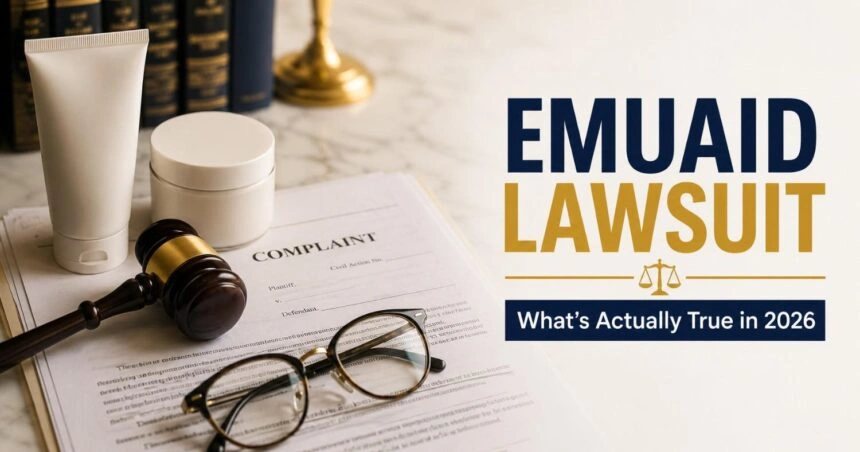
The clearest documented case connected to Emuaid is Clark v. Speer Laboratories, LLC, filed on December 1, 2020, in federal court in Pennsylvania. Plaintiff Karen Clark alleged that Speer Laboratories’ Emuaid website contained accessibility barriers affecting people who use screen readers.
Importantly, this was an ADA website-accessibility case, not a lawsuit alleging that Emuaid products were ineffective, dangerous, falsely advertised, or responsible for physical injuries.
According to the available case summary, Clark alleged that portions of the website could not be independently accessed by visually impaired users. The complaint invoked Title III of the Americans with Disabilities Act and sought relief including changes intended to make the website accessible.
That distinction matters because some online discussions use “Emuaid lawsuit” broadly. A lawsuit involving a company’s website does not automatically establish a legal problem with the company’s products.
| Question | Documented Information |
|---|---|
| Defendant | Speer Laboratories, LLC |
| Plaintiff | Karen Clark |
| Filing Date | December 1, 2020 |
| Main Legal Issue | Website accessibility |
| Legal Basis | Title III of the ADA |
| Product-defect case? | No |
| False-advertising class action? | Not this case |
Who Is Speer Laboratories?
Speer Laboratories, LLC is the company associated with EMUAID-branded products. Federal product-label records identify Speer Laboratories as the packager or distributor for multiple EMUAID products.
The company’s connection to the brand is also reflected in federal trademark records. Speer Laboratories has held and applied for trademarks covering EMUAID and EMUAIDMAX products, including skin-care preparations. A 2022 EMUAIDMAX trademark application identified Speer Laboratories, LLC as the owner and stated commercial use dating to 2012.
The company markets topical products intended for different skin-care and first-aid uses. Because individual EMUAID products can have different formulations and regulatory classifications, consumers should evaluate the specific product label rather than assuming every item sold under the brand has the same ingredients or regulatory status.
That distinction becomes particularly important when evaluating claims about FDA involvement or product approval.
What the ADA Lawsuit Actually Alleges
Clark’s complaint focused on whether visually impaired consumers could effectively use the Emuaid website with assistive technology.
According to a published summary of the complaint, alleged accessibility problems included an informational product matrix that did not communicate its content properly to screen-reader users. The plaintiff also alleged navigation problems involving the site’s menu and keyboard controls.
Another allegation concerned product-use information. The complaint reportedly claimed that screen-reader users could identify certain tabs but could not properly access the information contained within them.
The plaintiff asserted a claim under Title III of the ADA and sought declaratory and injunctive relief designed to require accessibility improvements, along with attorneys’ fees, costs, and other relief requested in the complaint.
These were allegations, not findings that Speer Laboratories intentionally discriminated against consumers. A complaint represents the plaintiff’s legal position unless and until the allegations are admitted, settled, or adjudicated.
What Happened After the Lawsuit Was Filed
The accessibility litigation appears in records connected with a group of ADA website-accessibility claims filed in federal court. Available reporting identifies Speer Laboratories among numerous defendants facing ADA theories during that litigation.
The public summaries available through general legal databases do not support treating the case as a consumer product class action or as evidence of a multimillion-dollar Emuaid compensation program.
This distinction is especially relevant for consumers encountering pages that discuss settlements or payouts without providing a docket number, named plaintiffs, court, complaint, settlement administrator, or judicial approval documents.
A real lawsuit can exist without supporting every allegation subsequently repeated online. Here, the documented dispute concerns digital accessibility. It should not be transformed into evidence that a court found Emuaid’s skin-care products unsafe or fraudulent.
The “False Advertising Class Action” Claim Fact-Checked
Some online pages describe an Emuaid false-advertising class action involving claims about skin conditions, product effectiveness, or regulatory approval. Those descriptions should be treated cautiously unless they identify verifiable court records.
A genuine federal class action normally leaves a substantial documentary trail. Readers should be able to identify details such as:
- The full case name
- Court and jurisdiction
- Filing date
- Docket or case number
- Named plaintiff and defendant
- Causes of action
- Complaint or other court filings
- Class-certification proceedings, where applicable
- Settlement documents if a settlement exists
The documented Clark litigation does not fit the description of a false-advertising class action. Its allegations concerned accessibility under the ADA.
As of this review, credible documentation located for this article does not substantiate the more dramatic online narrative of a major certified Emuaid consumer class action over false advertising. That does not mean litigation could never occur; it means claims about an existing case should not be presented as established fact without identifiable court records.
Emuaid Lawsuit Update
The most defensible current assessment is narrower than some search results suggest: Emuaid has been connected to documented litigation, but the verified case identified here concerns website accessibility rather than a large consumer product-liability or false-advertising class action.
Consumers should therefore distinguish three categories of information: actual court filings, individual consumer complaints, and speculative lawsuit content.
Negative reviews may be useful when evaluating a purchase. They are not, by themselves, evidence that a class action exists.
Similarly, questions about a product’s regulatory status may deserve scrutiny without proving that a court has found the manufacturer legally liable.
Is There an Active Emuaid Lawsuit?
The documented case commonly associated with Emuaid is the 2020 ADA accessibility action involving Karen Clark and Speer Laboratories. The available evidence reviewed for this article does not establish a current certified consumer class action alleging that Emuaid products were falsely advertised or ineffective.
Consumers should be particularly cautious about websites claiming there is an active settlement, compensation fund, or claim deadline without identifying the court and docket.
Legal status can change, so a current court-record search remains the best way to verify newly filed litigation.
What Happened in 2022?
One event that can create confusion is Speer Laboratories’ federal trademark activity in 2022.
On April 8, 2022, the company filed trademark applications for EMUAID and EMUAIDMAX covering pharmaceutical preparations for skin care. The EMUAIDMAX application identified Speer Laboratories as the owner and listed first commercial use dating to October 2012.
That was a trademark filing, not a class-action lawsuit.
Speer Laboratories also announced an expansion of EmuaidMAX distribution into thousands of Walgreens stores in July 2022. Neither event should be confused with proof that a new consumer lawsuit was filed that year.
What Is Emuaid?
Emuaid is a brand covering topical products marketed for skin care, first aid, pain relief, and related uses. Different products under the brand can have different active ingredients, labeling, and regulatory classifications.
For example, a current DailyMed entry identifies an EMUAID salicylic-acid topical product containing 2% salicylic acid and lists Speer Laboratories as the packager. Its inactive ingredients include sulfur, zinc oxide, camphor, and other substances.
Another federal label for an EMUAID pain-relieving cream identifies menthol as its active ingredient and describes temporary relief for minor muscle and joint aches associated with conditions such as strains, sprains, bruises, and simple backache.
Consumers therefore should not treat “Emuaid” as a single formulation. The exact label matters when considering ingredients, directions, warnings, and intended uses.
Understanding EMUAID MAX
EMUAID MAX is one of the better-known names within the brand’s product line. Trademark records show longstanding commercial use of the EMUAIDMAX name, including an earlier registration and later trademark activity by Speer Laboratories.
Historical federal labeling for an EMUAID silver ointment identifies it as a homeopathic product. DailyMed states that the product had not been evaluated by the FDA for safety or efficacy and notes that the FDA is not aware of scientific evidence supporting homeopathy as effective.
That regulatory language deserves careful interpretation.
The existence of a DailyMed listing or NDC does not necessarily mean the FDA has individually approved a product’s effectiveness. Likewise, a company’s operation within the OTC marketplace should not automatically be interpreted as an FDA endorsement of every marketing statement.
Consumers comparing EMUAID MAX or related formulations should rely on the current package labeling because formulations and regulatory information can change over time.
Emuaid Ingredients Explained
There is no single ingredient list that accurately describes every Emuaid product. Ingredients depend on the specific formulation.
For example, the current DailyMed entry for an EMUAID topical liquid lists 2% salicylic acid as the active ingredient. Other listed ingredients include isopropyl alcohol, water, sulfur, zinc oxide, camphor, ferric oxide red, and magnesium aluminum silicate.
Historical labeling for EMUAID silver ointment lists Argentum Metallicum as its homeopathic active ingredient. Other ingredients shown on the label include emu oil, tea tree oil, squalane, olive oil, allantoin, silver citrate, ceramide 3, and other components.
Consumers should read the ingredient panel of the exact product they intend to use, particularly if they have allergies, sensitive skin, take medications, or plan to apply the product to an unusual or persistent skin condition.
An ingredient’s presence also does not establish that a product will effectively treat every condition mentioned in reviews or online discussions.
Is Emuaid Real or Fake?
Emuaid is a real commercial brand associated with Speer Laboratories. Federal trademark and DailyMed records document the company and multiple EMUAID-branded products.
But asking whether a product is “real” can involve several different questions.
A product can be legitimately manufactured and sold while consumers disagree about how well it works. Likewise, legitimate branding does not mean every online statement about a product has been independently validated.
Federal labeling also requires nuance. DailyMed’s historical EMUAID silver ointment listing specifically states that the homeopathic product had not been evaluated by FDA for safety or efficacy.
Therefore, consumers should separate the existence of the brand from questions about efficacy. Whether a particular formulation is appropriate for an individual’s condition is a medical question rather than something established by branding, testimonials, or lawsuit rumors.
Why Are Emuaid Reviews So Mixed?
Mixed reviews are common with topical products because users may be treating different conditions, using different formulations, or expecting different outcomes.
Skin symptoms that look similar can also have different causes. Itching, redness, scaling, irritation, and discoloration may arise from multiple conditions, meaning one person’s experience does not reliably predict another person’s outcome.
Online reviews can still reveal useful patterns. Consumers may discuss:
- Whether the product met their expectations
- Skin irritation or sensitivity
- Texture, smell, or application
- Price and perceived value
- Shipping or customer-service experiences
- Refund or subscription concerns
- How quickly they expected results
The key is not to convert those experiences into clinical or legal conclusions. A negative review is evidence of one consumer’s reported experience—not proof that a product is defective, illegal, or fraudulently marketed.
Looking at Negative Consumer Reviews
Negative reviews deserve consideration, particularly when similar issues appear repeatedly. However, they need context.
Someone reporting that a topical product “didn’t work” may have used it for a condition it was not designed to treat, discontinued it quickly, experienced an individual reaction, or simply obtained no meaningful benefit.
Other complaints can involve matters unrelated to effectiveness, such as pricing, shipping, refunds, recurring orders, or customer support.
From a legal perspective, dissatisfaction becomes more significant when evidence shows a specific representation was materially false or misleading and consumers reasonably relied on that representation when making a purchase.
That is a much higher evidentiary threshold than simply collecting unfavorable online reviews.
What Reddit Discussions Reveal About Emuaid
Reddit discussions can provide unfiltered consumer experiences, but they should be treated as anecdotal evidence.
Users may discuss whether they thought Emuaid helped a particular skin problem, whether they considered the price worthwhile, how it compared with alternatives, or whether they experienced irritation. Other users may strongly disagree.
Those discussions can be useful for identifying questions to research further. They cannot determine whether a medical claim is scientifically established.
Reddit posts also cannot establish that an Emuaid class action exists. A statement that someone “should sue” a company is fundamentally different from an attorney filing a complaint in court, obtaining class certification, or negotiating a court-approved settlement.
Does a Large Number of Complaints Mean a Product Is Illegal?
No. Even a substantial volume of complaints does not automatically make a product illegal.
Consumer complaints are signals. Regulators, courts, attorneys, and companies may examine those signals, but legal liability normally requires additional evidence.
Depending on the issue, relevant questions may include whether:
- Advertising contained materially misleading representations
- Product labeling complied with applicable requirements
- Consumers suffered measurable losses
- A product caused an alleged injury
- The company knew or should have known about a problem
- The challenged conduct violated a specific consumer-protection law
A popular product may accumulate both positive and negative reviews simply because many people buy it.
Conversely, a relatively small number of complaints can sometimes reveal a serious issue. The evidentiary quality and nature of the allegations matter more than raw review counts.
Has the FDA Recalled Emuaid?
A distinction must be made between FDA labeling information, regulatory status, and an FDA recall.
The federal DailyMed records reviewed for this article contain EMUAID-branded product listings, including a salicylic-acid topical product updated in January 2026.
Historical labeling for EMUAID silver ointment states that it was an unapproved homeopathic product and had not been evaluated by the FDA for safety or efficacy. That statement should not automatically be rewritten as “FDA recalled Emuaid.”
Similarly, DailyMed notes for some OTC products explain that many OTC drugs are not individually reviewed and approved by the FDA in the way consumers may assume.
Based on the sources reviewed for this article, we did not identify evidence supporting a broad claim that the FDA has recalled the entire Emuaid brand. Consumers concerned about a particular product should check current FDA recall notices using the exact product name and lot information.
How to Spot a Fake or Speculative Lawsuit Page
Lawsuit-related content can rank in search results even when its claims are poorly sourced. Readers should therefore verify the legal foundation before relying on an article.
A credible lawsuit report should usually answer basic questions:
- Who filed the lawsuit?
- Who is being sued?
- When was it filed?
- Which court received the complaint?
- What is the docket number?
- What causes of action were alleged?
- Has the court certified a class?
- Is there an official settlement administrator?
Be skeptical when a page repeatedly mentions a “major class action” but provides none of those details.
Settlement claims deserve even greater scrutiny. A legitimate class-action settlement typically produces identifiable documents covering preliminary or final approval, class definitions, deadlines, exclusions, objections, attorneys’ fees, and claim procedures.
A page promising compensation without verifiable documentation may simply be speculating or generating leads.
Can You Actually Sue Over Skincare Marketing Claims?
Potentially, yes. Skincare companies are not immune from advertising, consumer-protection, warranty, or product-liability laws.
A viable claim, however, depends on the facts and applicable jurisdiction. A consumer generally needs more than disappointment with the product.
Potential legal theories could involve allegedly false representations about what a product does, misleading labeling, undisclosed material information, breach of warranty, or injury allegedly caused by a defective product.
For a false-advertising claim, important questions may include what the company actually represented, whether the representation was material, whether it was misleading, whether the consumer relied on it, and what economic loss resulted.
Product-injury cases involve different elements and may require medical records, expert evidence, proof of causation, and documentation showing how the product was used.
The existence of those legal theories does not establish that any particular claim against Emuaid would succeed.
What to Do If You Believe You Were Misled
Consumers who believe they purchased a product because of misleading representations should preserve evidence before taking further action.
Useful records may include:
- Product packaging and labels
- Purchase receipts
- Order confirmations
- Screenshots of advertising claims
- Emails with customer support
- Refund requests and responses
- Photographs of an alleged reaction
- Medical records where an injury is involved
First, consider contacting the seller or manufacturer to request clarification or pursue available refund procedures.
For significant financial loss or alleged physical injury, a consumer-protection or product-liability attorney can evaluate whether the facts potentially support a legal claim. An attorney can also distinguish an actionable misrepresentation from ordinary advertising language, personal dissatisfaction, or a product simply failing to produce the expected result.
Consumers should seek medical attention for persistent or serious reactions rather than relying solely on online discussions.
How to Evaluate Product Claims Before Buying
Marketing language can make topical products sound suitable for a wide range of problems. Before purchasing, consumers should separate promotional statements from verified label information and independent evidence.
A useful evaluation combines the ingredient list, official labeling, credible medical information, independent reviews, and realistic expectations.
Read the Ingredient List
Check the ingredients of the specific formulation, not a generic ingredient list found in an old review.
Emuaid products can differ considerably. For example, federal records show one formulation using salicylic acid while other historical products have different active ingredients.
Pay particular attention to known allergens or ingredients that have previously irritated your skin.
Check Independent Reviews
Look beyond testimonials appearing on a manufacturer’s own website.
Independent reviews can reveal recurring experiences involving effectiveness, irritation, customer service, shipping, refunds, or value. However, reviews should be viewed as anecdotal information.
A useful approach is to identify repeated themes rather than treating the most enthusiastic or angry review as representative of every buyer’s experience.
Review Medical Guidance
For persistent, painful, infected, spreading, or unexplained skin symptoms, professional medical guidance is more reliable than self-diagnosis through product reviews.
Some skin conditions resemble one another but require very different treatments.
Product labeling itself may also instruct consumers to stop use or consult a healthcare professional when symptoms worsen or persist. Following those warnings is more appropriate than continuously experimenting with topical products.
Understand Marketing Language
Pay close attention to the difference between statements such as “helps relieve,” “temporarily relieves,” “supports,” and claims that a product cures or permanently eliminates a condition.
Those phrases can carry different medical and legal implications.
Consumers should also avoid assuming that terms such as “registered,” an NDC number, or appearance in a federal labeling database necessarily mean the FDA has independently verified every efficacy claim associated with the product.
Compare Alternatives
Price, ingredients, intended use, supporting evidence, and medical guidance should all factor into the comparison.
A heavily marketed product is not necessarily the best choice for every condition. Conversely, negative internet commentary does not automatically mean an alternative will work better.
Compare products based on the specific problem you are trying to address rather than brand popularity alone.
Where to Buy EMUAID
EMUAID products have been sold through the brand’s own retail channels and third-party retailers. Speer Laboratories announced in 2022 that larger EMUAIDMAX products were expanding into thousands of Walgreens locations.
Availability can change, so consumers should confirm current inventory directly with the seller.
When buying online, check the seller, packaging, product name, ingredient panel, expiration information where applicable, and return policy. Be cautious about unusually low-priced listings from unfamiliar marketplaces because authenticity and storage conditions can be difficult to verify.
Purchasing from a recognized retailer does not guarantee that a product will work for a particular condition. It primarily helps reduce uncertainty about where the product originated.
Read: Cora Tampons Lawsuit
Read: Dr. Kevin Sadati Lawsuit
Read: The Wellness Company Lawsuit
Read: Generational Equity Lawsuit
Read: Trellis Law
Read: Fischer Homes Lawsuit
Read: Venmo Class Action Lawsuit
Read: Exploring CNLawBlog
FAQ
Is there a real Emuaid lawsuit?
Yes. A documented 2020 federal case, Clark v. Speer Laboratories, involved allegations that the Emuaid website was inaccessible to visually impaired users under the ADA.
Is the Emuaid lawsuit a false-advertising class action?
The verified Clark case was not a false-advertising class action. It concerned website accessibility. Claims of a separate major consumer class action should be verified through identifiable court filings.
Was there an Emuaid settlement?
The sources reviewed do not establish a broad consumer settlement or compensation fund relating to alleged Emuaid false advertising. Consumers should distrust payout claims that provide no court or settlement documentation.
Was Emuaid sued because its products do not work?
The documented Clark lawsuit did not concern product effectiveness. It alleged ADA accessibility problems involving the company’s website, rather than proving that Emuaid products were ineffective or defective.
Is Emuaid FDA approved?
The answer depends on the product and what “approved” means. Historical DailyMed labeling for EMUAID silver ointment specifically states that the homeopathic product was not evaluated by FDA for safety or efficacy.
Has the FDA recalled Emuaid?
The sources reviewed here do not support describing the entire Emuaid brand as subject to an FDA recall. Consumers should search current FDA recall information for the exact product and lot.
Conclusion
The Emuaid lawsuit story is narrower than some online descriptions make it appear. The clearest documented litigation is Clark v. Speer Laboratories, a 2020 federal ADA case concerning alleged accessibility barriers on the Emuaid website. It should not be confused with proof of a product-safety or false-advertising class action.
Claims about large settlements, consumer payouts, or an established false-advertising class action deserve verification before being repeated. Court names, docket numbers, filed complaints, class-certification orders, and official settlement documents provide much stronger evidence than unsourced lawsuit pages.
Consumers evaluating Emuaid should separately consider product labeling, ingredients, independent reviews, medical guidance, and regulatory information. Negative experiences may raise legitimate questions, but legal liability ultimately depends on evidence, applicable law, and decisions made through the appropriate court or regulatory process.