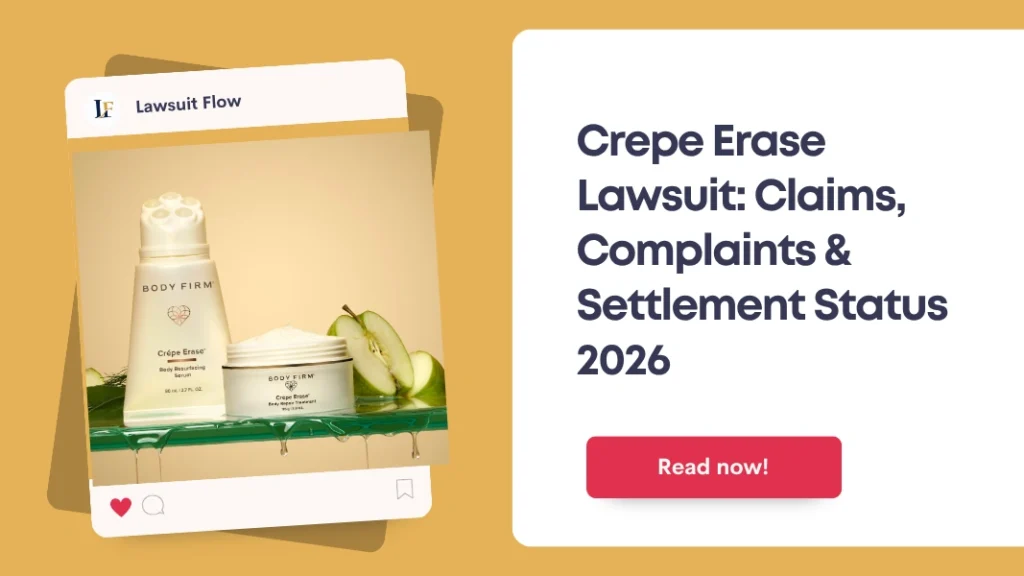

Crepe Erase is a skincare line sold by The Body Firm, LLC and marketed for dry, thin, or “crepey” skin. Interest in the Crepe Erase Lawsuit has increased as consumers encounter reports about subscription practices, recurring charges, cancellations, pricing, and other purchasing concerns.
The legal picture requires some care. Consumer complaints about billing and subscriptions exist, while a proposed federal class action filed in November 2025 alleges deceptive discount pricing involving The Body Firm’s Age-Defying Body & Face Kit. Those are related consumer-protection issues, but they should not be treated as identical legal claims.
This article explains the documented lawsuit, reported subscription complaints, applicable consumer-protection principles, settlement status, and what customers should know before assuming they qualify for compensation.
What Is Crepe Erase?

Crepe Erase is a skincare brand associated with The Body Firm. Its products are marketed primarily toward consumers seeking to improve the appearance of dry, textured, loose, or crepey-looking skin.
The product line includes body treatments, facial products, and kits. The company also offers membership or replenishment arrangements that can provide continuing product deliveries. Its current FAQ describes member savings and scheduled replenishment deliveries.
That recurring-delivery model is important to understanding why the brand appears in consumer complaints. Some customers report that they believed they were making a one-time purchase or did not fully understand the timing or cost of subsequent payments and shipments.
Those reports are distinct from proof that a law was violated. Whether a subscription practice is unlawful generally depends on what terms were presented, how clearly they were disclosed, whether valid consent was obtained, and whether customers were provided legally adequate cancellation options.
Why Consumers Raised Concerns About Crepe Erase
Public complaints concerning Crepe Erase frequently focus on the purchasing experience rather than solely on the skincare products themselves.
BBB complaint and review records include customers who say they encountered recurring charges, replenishment shipments, outstanding installment balances, or difficulty understanding or ending their memberships. Crepe Erase has responded to a number of these complaints, sometimes explaining its payment structure and, in individual cases, providing refunds or account adjustments.
These reports help explain why consumers search for legal information about the brand. They do not, by themselves, establish liability or prove that every customer had the same experience.
Automatic Renewal Complaints
Some customers have alleged that they did not realize their initial Crepe Erase purchase was connected to continuing deliveries or payments.
For example, BBB records contain complaints from consumers describing later charges after what they believed was a one-time transaction. Other customers have complained about receiving notice of another shipment sooner than expected.
Crepe Erase has responded to complaints by stating that certain offers include a home-delivery membership and that terms are disclosed during the ordering process. The existence of conflicting consumer and company accounts is important: a complaint records an allegation, not a judicial finding.
Unexpected or Recurring Charges
Recurring charges are another major source of consumer concern.
The issue can be complicated because a later charge does not always represent a new shipment. Crepe Erase has explained in BBB responses that some orders are divided into multiple scheduled payments, meaning cancellation of future shipments may not automatically eliminate amounts still owed for products already shipped.
For consumers, the distinction between installment billing and a new recurring order can be confusing. Legally, the relevant questions can include what the customer authorized and whether payment and renewal terms were presented clearly before the transaction.
Subscription Cancellation Concerns
Customers have also reported frustration with cancellation procedures. Complaints describe difficulties contacting customer service, managing accounts, stopping shipments, or understanding what amounts remain due after cancellation.
The company’s published customer-service information states that future orders may be canceled through the customer portal or customer service. It also explains that an order close to shipment may not be cancelable and that unpaid balances for previously shipped orders may continue to be billed.
Those terms matter when assessing an individual billing dispute.
How the Crepe Erase Subscription Model Works
The Body Firm describes its membership program as offering discounted pricing and flexible replenishment deliveries. Customers participating in such an arrangement may receive additional products according to their delivery schedule unless future shipments are changed or canceled.
Consumers should distinguish between three separate events: a new replenishment shipment, an installment payment for merchandise already shipped, and a charge associated with another purchase. These transactions can appear similar on a bank statement while having different contractual explanations.
Published customer-service information also states that canceling future orders does not necessarily erase an unpaid balance for an order that has already shipped. Customers may instead need to return qualifying merchandise under the applicable money-back policy to receive credit.
From a consumer-protection perspective, the key question is whether material subscription and payment terms were adequately communicated before consent was obtained.
What Is the Crepe Erase Lawsuit About?
There is an important distinction between the Crepe Erase Lawsuit people commonly search for and the lawsuit that can presently be verified through a federal court complaint.
On November 20, 2025, Teresa Roberts filed a proposed class action against The Body Firm, LLC in the U.S. District Court for the Central District of California. The complaint concerns the Age-Defying Body & Face Kit and primarily alleges a false discount pricing scheme—not the recurring-subscription allegations that dominate many consumer reviews.
The plaintiff alleges that The Body Firm advertised a purported 25% discount from a regular price that it allegedly did not actually charge and used limited-time messaging or countdown tactics that allegedly created artificial urgency. These remain allegations unless established through the litigation.
The complaint seeks damages, restitution, declaratory and injunctive relief, attorneys’ fees, and other remedies under several California legal theories.
The Origins of Legal Scrutiny Involving Crepe Erase
Legal interest surrounding the brand comes from more than one source. The most concrete recent development is Roberts v. The Body Firm, LLC, the proposed class action filed in November 2025 over allegedly misleading pricing representations.
The complaint alleges that the plaintiff purchased an Age-Defying Body & Face Kit for $59.95 after seeing an advertised 25% discount. She claims she relied on the representation and would not have purchased the product, or would not have purchased it on the same terms, had she known the alleged limited-time sale was not genuine.
Separately, subscription concerns have attracted attention because of consumer complaints and the history of Guthy-Renker, which has been associated with Crepe Erase marketing. In 2019, Guthy-Renker settled an $8.5 million California enforcement action concerning automatic-renewal practices involving Wen and Proactiv customers. That settlement should not be mischaracterized as a Crepe Erase settlement.
Allegations in the Crepe Erase Lawsuit
The verified 2025 federal complaint primarily targets alleged pricing representations. It asserts claims under California’s False Advertising Law, Consumers Legal Remedies Act, and Unfair Competition Law, along with misrepresentation, contract, and warranty theories.
At the same time, consumers searching for this case frequently encounter separate allegations about subscriptions and recurring billing. Keeping those two categories separate avoids overstating what the pending complaint actually alleges.
Auto-Renewal Allegations
Public consumer complaints contain allegations that some customers did not understand that their purchases would lead to continuing shipments or charges. Some consumers describe believing they had placed a one-time order before discovering what they considered an unexpected subscription.
However, the verified Roberts class-action complaint is centered on alleged false discount pricing. Consumers should therefore avoid assuming that every online reference to an “auto-renewal lawsuit” describes the claims pleaded in that case.
Subscription complaints could potentially raise separate consumer-protection questions depending on the transaction and applicable law.
Billing and Subscription Claims
Billing complaints generally involve disputed recurring charges, installment payments, or charges consumers say continued after they attempted to cancel.
Crepe Erase has responded publicly to some complaints by explaining that cancellation stops future shipments but may not eliminate balances owed on merchandise that already shipped. In several BBB cases, the company also reported issuing refunds, clearing balances, or closing accounts as individual resolutions.
Such resolutions are customer-service outcomes. They should not be described as judgments, admissions of liability, or class-action settlement payments.
Cancellation and Disclosure Concerns
Disclosure and cancellation are central issues in negative-option marketing law.
Consumers have reported difficulty determining how to cancel or understanding the financial consequences of cancellation. The company, meanwhile, publishes cancellation instructions and says customers can manage future orders through its portal or customer-care channels.
If a legal dispute arose from these circumstances, relevant evidence could include checkout pages, order confirmations, membership disclosures, cancellation records, correspondence, shipping records, and bank or credit-card statements.
Consumer Protection Allegations
The Roberts complaint expressly alleges violations of California consumer-protection statutes based on allegedly deceptive discount pricing. The plaintiff contends that advertised reference prices and limited-time promotions misled reasonable customers about the value of the deal.
Those allegations have not been presented here as proven facts.
Separately, recurring-subscription practices can implicate federal and state consumer laws when businesses allegedly fail to disclose material terms, obtain adequate authorization, or provide legally sufficient cancellation mechanisms.
Whether any particular Crepe Erase transaction violated those requirements would depend on the evidence and governing law.
Understanding Auto-Renewal Laws
Automatic-renewal and negative-option programs are generally legal when businesses follow applicable disclosure, consent, and cancellation requirements.
Federal law is particularly relevant to online transactions. The FTC explains that the Restore Online Shoppers’ Confidence Act, or ROSCA, restricts online negative-option billing unless material terms are clearly disclosed, express informed consent is obtained, and a simple method is provided to stop recurring charges.
State laws can impose additional obligations. California, for example, has its own automatic-renewal requirements.
This legal framework explains why seemingly small details—such as where subscription language appears during checkout—can become important evidence in consumer litigation.
Required Subscription Disclosures
Material subscription terms should be presented clearly enough for consumers to understand what they are accepting.
Depending on the transaction and governing law, important information can include:
- The amount consumers will be charged.
- How frequently charges will occur.
- Whether products will be shipped automatically.
- When promotional pricing ends.
- How and when customers may cancel.
The FTC has emphasized that material negative-option terms should be clearly communicated before consumers provide billing information or become bound by recurring arrangements.
Consumer Consent Requirements
Disclosure alone may not resolve the legal issue. Businesses using online negative-option arrangements generally must obtain the consumer’s express informed consent before charging the account.
ROSCA specifically addresses this issue for internet transactions. The FTC states that businesses must obtain express informed consent before charging consumers through covered negative-option arrangements.
In a dispute, evidence of consent could include the checkout interface, confirmation screens, electronic records, order acknowledgments, or other documentation showing what the consumer saw and accepted.
Cancellation Requirements
Cancellation is another core component of negative-option regulation.
FTC consumer guidance says businesses must provide information about how to cancel and that consumers encountering unauthorized post-cancellation charges should preserve records and consider disputing charges with their card issuer.
The precise legal requirements depend on the law applicable at the relevant time and place. That distinction is important because federal subscription regulation has undergone significant rulemaking and litigation in recent years.
Consumers should therefore evaluate their transaction under the rules actually applicable when it occurred rather than assuming every recently announced regulatory standard automatically governs an older purchase.
Legal Background of the Crepe Erase Lawsuit
The strongest documented basis for describing current litigation is the November 2025 Roberts complaint.
The plaintiff alleges that The Body Firm used an artificial former price and an allegedly perpetual or misleading limited-time discount to make its Age-Defying Body & Face Kit appear more heavily discounted than it really was. According to the complaint, these representations allegedly influenced purchasing decisions.
The proposed causes of action include:
- California False Advertising Law claims.
- California Consumers Legal Remedies Act claims.
- California Unfair Competition Law claims.
- Negligent and intentional misrepresentation.
- Breach of contract.
- Breach of express warranty.
A class-action complaint represents the plaintiff’s allegations. Filing one does not establish that the defendant violated the law, and a proposed class does not become a certified class merely because class allegations appear in the complaint.
What Consumer Protection Laws May Apply?
Different consumer-protection statutes may apply depending on whether a dispute involves pricing, advertising, subscriptions, or billing.
The Roberts complaint invokes California’s False Advertising Law, Consumers Legal Remedies Act, and Unfair Competition Law. It alleges that false or misleading former-price comparisons and purported limited-time discounts violated these protections.
For online recurring subscriptions, ROSCA can also be relevant. The FTC explains that covered businesses generally must disclose material negative-option terms, obtain express informed consent, and provide simple cancellation mechanisms.
The Federal Trade Commission Act can separately prohibit unfair or deceptive acts or practices.
State automatic-renewal statutes and general consumer-protection laws may add further requirements. Which statute applies to a particular customer depends on factors such as where the transaction occurred, how the purchase was made, what representations appeared during checkout, and when the conduct happened.
What Role Does the FTC Play in Subscription Practices?
The Federal Trade Commission enforces federal consumer-protection laws and has long addressed negative-option marketing, including continuity programs, automatic renewals, and subscription arrangements.
The agency’s guidance warns that problems arise when businesses fail to make continuing billing clear or create unreasonable obstacles to cancellation. It advises consumers to review subscription terms, understand cancellation procedures, retain records, and dispute unauthorized charges where appropriate.
The FTC announced an expanded “click-to-cancel” Negative Option Rule in October 2024, designed to strengthen disclosure, consent, and cancellation protections.
However, consumers should not interpret general FTC regulation as proof that the FTC has found Crepe Erase specifically liable for the complaints discussed here. Regulatory principles explain the legal framework; they are not a substitute for a case-specific enforcement action or court judgment.
How Similar Subscription Lawsuits Relate to Crepe Erase
Past Guthy-Renker litigation provides useful context but must be described accurately.
In 2019, California prosecutors announced an $8.5 million settlement with Guthy-Renker over allegations involving automatic payment renewals. The settlement included $1.2 million in penalties and up to $7.3 million in consumer restitution.
Importantly, the restitution groups identified by prosecutors involved Wen customers charged after May 2012 and certain Proactiv customers charged between July 2014 and August 2016. Crepe Erase purchasers were not identified as the restitution group in that announcement.
The earlier case demonstrates how regulators evaluate recurring-payment disclosures and consent. It does not establish that Crepe Erase customers are automatically entitled to money from that settlement.
The distinction is particularly important for consumers encountering websites that combine different Guthy-Renker disputes under one broad “Crepe Erase lawsuit” label.
What Customers Report About Crepe Erase
Customer reports provide useful insight into why the legal search term has gained attention, but they must be treated as anecdotal evidence rather than established legal findings.
Recent BBB records contain complaints about unexpected charges, subscriptions consumers say they did not knowingly request, cancellation problems, outstanding balances, and confusion over replenishment orders.
Some disputes have been resolved through refunds, balance adjustments, or account cancellations. Others contain differing accounts from the consumer and the company.
Billing Complaints
Billing complaints commonly involve customers who say they expected one payment but later encountered another charge.
Some customers report believing later debits represented unauthorized new purchases. Company responses sometimes state that those payments represented installments for products already shipped rather than a separate order.
This distinction may be legally significant. A consumer evaluating a disputed charge should compare the transaction date with invoices, shipment records, the original payment schedule, and any cancellation confirmation before determining what the charge represents.
Cancellation Experiences
Some customers describe cancellation as frustrating or difficult. Reports include problems reaching customer support, managing subscriptions online, or stopping orders already being processed.
Crepe Erase’s published customer-service information says customers may manage future orders through a portal or contact customer service. It also states that shipments close to processing may not be cancelable, although qualifying merchandise may be returned under the applicable return policy.
Consumers should retain written cancellation confirmations whenever possible.
Product and Subscription Complaints
Not every complaint concerns the same issue. Some customers criticize product performance or value, while others focus almost entirely on enrollment, billing, shipping, or cancellation.
These categories should not be combined automatically.
Dissatisfaction with a cosmetic product does not necessarily establish false advertising, just as a billing disagreement does not necessarily prove unauthorized enrollment. A viable legal claim generally requires evidence connecting specific conduct to a recognized cause of action and measurable harm.
The current federal litigation provides a useful example: its central allegations concern purportedly deceptive discount pricing rather than simply whether customers liked the skincare products.
Current Status of the Crepe Erase Lawsuit
As of August 2026, the clearest verified federal proceeding relevant to Crepe Erase is Roberts v. The Body Firm, LLC, filed November 20, 2025 in the Central District of California as Case No. 2:25-cv-11126. The complaint seeks to proceed on behalf of a proposed class and challenges alleged false discount practices.
The original complaint does not establish liability, and consumers should not treat allegations as a final court determination.
| Question | Current Information |
|---|---|
| Federal lawsuit filed? | Yes, a proposed class action was filed in November 2025 |
| Main verified lawsuit issue | Allegedly deceptive discount and pricing representations |
| Subscription complaints reported? | Yes |
| Class-wide liability established? | Not established by the complaint |
| Crepe Erase-specific settlement confirmed? | No broadly verified settlement identified |
| Universal payout available? | No verified universal payout identified |
Consumers should also distinguish this litigation from the 2019 Guthy-Renker auto-renewal settlement, which specifically identified Wen and Proactiv customers for restitution rather than Crepe Erase purchasers.
Has There Been a Crepe Erase Lawsuit Settlement?
No broadly verified, court-approved Crepe Erase Lawsuit settlement establishing a universal compensation program for Crepe Erase purchasers was identified in the public materials reviewed for this August 2026 update.
That distinction matters because Guthy-Renker has previously entered a significant auto-renewal settlement. The 2019 California resolution required $1.2 million in penalties and up to $7.3 million in restitution, but the official announcement identified eligible Wen and Proactiv customers.
Individual Crepe Erase consumers have also received refunds, balance adjustments, or other resolutions according to BBB complaint responses. Those private customer-service resolutions are not equivalent to a class-action settlement.
Consumers should therefore be cautious about unofficial pages promising a guaranteed Crepe Erase payout or asking for financial information based on an alleged settlement. An authentic class settlement normally provides a court, case number, settlement administrator, eligibility definition, deadlines, and official claim instructions.
Who Could Potentially Qualify for a Crepe Erase Claim?
Potential eligibility depends on what type of claim is being discussed. There is currently no basis for saying that every Crepe Erase customer qualifies for compensation.
The Roberts complaint proposes claims involving purchasers allegedly induced by the challenged discount representations. Whether a class is ultimately certified, who falls within its definition, and what relief may become available depend on subsequent court proceedings.
Separately, a consumer with an individual subscription or billing dispute might have a different potential claim if evidence shows legally inadequate disclosure, lack of authorization, improper billing, or another actionable practice.
Useful records may include:
- Original order confirmations and invoices.
- Screenshots of checkout or promotional pages.
- Membership and automatic-delivery terms.
- Credit or debit card statements.
- Shipment dates and tracking records.
- Cancellation requests and confirmations.
- Customer-service emails or chat transcripts.
- Refund and return documentation.
Consumers should preserve those materials even when they are uncertain whether legal action is appropriate. Documentation can help establish what was represented, what was authorized, what was charged, and how the company responded.
Read: Method Body Wash Lawsuit
Read: Yellow Freight Lawsuit
Read: Sierra Mist Lawsuit
Read: 100 Day Dream Home Lawsuit
Read: Cora Tampons Lawsuit
Read: The Wellness Company Lawsuit
Read: Dr. Kevin Sadati Lawsuit
Read: MyChart Lawsuit Settlement
Read: Generational Equity Lawsuit
Frequently Asked Questions
Is there a lawsuit against Crepe Erase?
Yes. A proposed federal class action was filed against The Body Firm in November 2025 concerning allegedly deceptive discount pricing for its Age-Defying Body & Face Kit. The allegations have not been established as liability.
What is the Crepe Erase lawsuit about?
The verified 2025 complaint primarily alleges misleading former-price discounts and limited-time sales tactics. Separate consumer complaints involve subscriptions, billing, recurring shipments, and cancellation issues.
Is the Crepe Erase lawsuit about automatic renewals?
Not primarily in the verified Roberts complaint. Auto-renewal concerns appear extensively in consumer complaints, while the current federal class-action complaint focuses principally on allegedly deceptive pricing and discount representations.
Has Crepe Erase reached a class action settlement?
No broadly verified Crepe Erase-specific class settlement with a universal compensation program was identified for this August 2026 update. Earlier Guthy-Renker settlements involving other brands should not be confused with Crepe Erase.
Was the $8.5 million Guthy-Renker settlement for Crepe Erase customers?
No. The official 2019 announcement identified eligible Wen and certain Proactiv customers. It should not be presented as an $8.5 million Crepe Erase settlement.
What should I do if Crepe Erase charged me after cancellation?
Keep cancellation records and billing statements, contact the company, and document its response. FTC guidance also recommends disputing unauthorized charges with the card issuer when appropriate and preserving supporting records.
Final Thoughts
The Crepe Erase Lawsuit search term covers several issues that should not be blended together. A proposed federal class action filed in November 2025 challenges allegedly deceptive discount pricing by The Body Firm, while separate consumer reports describe recurring charges, subscriptions, billing confusion, and cancellation difficulties.
There is also historical litigation involving Guthy-Renker’s automatic-renewal practices, but the well-documented 2019 settlement identified Wen and Proactiv customers rather than establishing a Crepe Erase-specific restitution program.
Consumers with disputed charges should preserve purchase, billing, shipment, and cancellation records. Any right to compensation will depend on the facts, applicable consumer-protection law, and future court rulings or settlement terms—not simply on having purchased Crepe Erase.