


The Kim Muratori Mercedes-Benz lawsuit centers on a certified pre-owned 2018 Mercedes-Benz E 400 Coupe purchased from Mercedes-Benz of Fort Lauderdale in November 2022. What began as concerns about the vehicle’s condition eventually became a consumer dispute involving mileage, certified pre-owned documentation, warranty representations, arbitration, and court enforcement.
Muratori pursued claims against the dealership after discovering problems that she believed were inconsistent with how the vehicle had been represented. An arbitrator ultimately ruled in her favor on multiple claims and ordered substantial financial relief, but the dispute did not immediately end there.
The case is especially useful for understanding the limits of certified pre-owned programs, Florida consumer-protection law, arbitration, and the real cost of enforcing a favorable award.
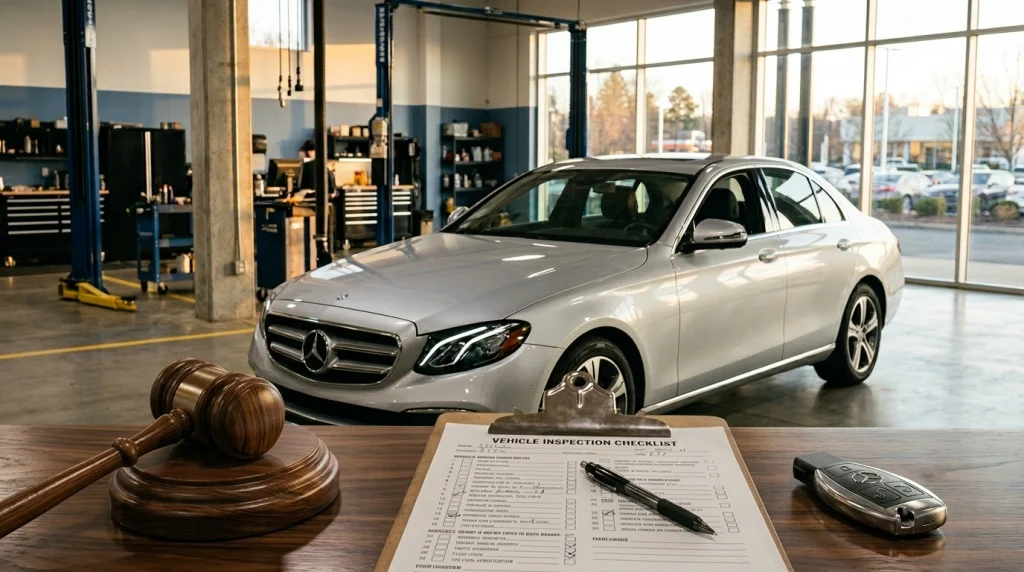
What Happened in the Kim Muratori Mercedes-Benz Lawsuit?
Kim Muratori purchased the 2018 Mercedes-Benz E 400 Coupe from Mercedes-Benz of Fort Lauderdale on November 5, 2022. The purchase price was close to $55,000, with a $15,000 down payment and the remaining balance financed. The retail agreement identified the car as certified pre-owned, or CPO.
Problems developed later. In August 2023, Muratori discovered that the front bumper cover had become detached and that a zip tie had been used to secure it. The dealership repaired that issue without charging her. Months later, an independent diagnostic scan produced mileage readings from the vehicle’s onboard computers that were substantially higher than the dashboard odometer reading.
Muratori also encountered suspension concerns. An independent repair shop advised her in March 2024 that components on the right-front suspension were sufficiently deteriorated that the vehicle was unsafe to drive. The arbitration record notes there was a dispute over the cause of the suspension damage.
The dispute eventually proceeded through AAA consumer arbitration. The arbitrator found problems with representations concerning the mileage and CPO status and granted rescission-related relief. Later, when the dealership sought to vacate the award, a Broward County judge rejected that challenge and confirmed the award.
Full Timeline of the Kim Muratori Lawsuit: 2022 to 2026
The dispute developed over several years rather than through a single lawsuit filed immediately after the purchase.
| Date | Development |
|---|---|
| November 2022 | Muratori purchases the certified pre-owned 2018 Mercedes-Benz E 400 Coupe. |
| August 2023 | She discovers the detached bumper cover and zip tie. |
| November–December 2023 | Mileage concerns emerge; demand letters are sent to the dealership. |
| February 2024 | Muratori initiates AAA consumer arbitration. |
| March 2024 | An independent shop identifies serious right-front suspension concerns. |
| April 24–25, 2025 | The arbitrator holds a virtual evidentiary hearing. |
| 2025 | Muratori receives a favorable arbitration award; a later AAA-level challenge does not overturn it. |
| January 30, 2026 | Broward County Circuit Court denies the dealership’s motion to vacate and confirms the award. |
| April 2026 | The vehicle is finally taken back; AutoNation says the dealership fulfilled its obligations following the court decision. |
The arbitration record shows that Muratori herself filed an AAA demand in February 2024, meaning descriptions of the dispute as beginning in May 2024 or 2025 can be misleading. The evidentiary arbitration hearing occurred in April 2025.
By April 2026, CBS Miami reported that the Mercedes had finally been removed after sitting for roughly 25 months. AutoNation stated that its obligations following the court decision had been fulfilled.
What Was Actually Wrong With the Car?
Several different issues became part of Muratori’s dispute. They should not be treated as though each one was independently proven to have the same legal significance.
The arbitration focused heavily on the vehicle’s represented mileage and CPO status. The bumper and suspension problems also contributed to Muratori’s concerns about the condition and history of the vehicle.
The Zip-Tied Bumper
In August 2023, Muratori returned to her parked car and found that its front bumper cover had become detached. Inspection revealed that part of the bumper cover had been secured using a zip tie.
The arbitrator did not treat this as an unrepaired defect that independently established the entire case. The award noted that the dealership repaired the bumper issue and Muratori did not have to pay for that repair.
Its significance was broader. The unusual condition raised questions for Muratori about the vehicle she had purchased as certified pre-owned and prompted greater scrutiny of its history and condition.
The Odometer Discrepancy
Mileage became one of the most important parts of the case.
An independent mechanic used an Autel diagnostic tool and obtained readings indicating that the dashboard showed 39,179 miles while internal computer data reflected 114,688 kilometers, equivalent to more than 71,000 miles.
The dealership questioned the reliability of the third-party diagnostic device and had access to Mercedes-Benz’s Xentry system, which witnesses indicated could examine vehicle computer components. The arbitration decision noted that the dealership did not produce a definitive Xentry test resolving the discrepancy.
The arbitrator ultimately found that the mileage represented in the contract was inaccurate based on the evidence presented. Importantly, that finding does not itself establish who, if anyone, altered the odometer. Two previous users who testified denied tampering with it.
The Damaged Suspension
In March 2024, Muratori took the Mercedes to Davie Automotive after hearing a concerning noise from the right-front area. The shop advised her that suspension components were sufficiently deteriorated that the vehicle was unsafe to drive and required her to sign a release before taking it.
A Mercedes-Benz dealership in Palm Beach later documented front-end suspension work and underbody-related repairs.
The arbitration record also makes an important qualification: the parties disputed whether the suspension condition resulted from misuse or ordinary wear. The arbitrator therefore did not simply treat every mechanical problem as conclusively caused by wrongdoing at the selling dealership.
The Missing Certified Pre-Owned Checklist
The missing CPO documentation became central to the dispute.
The dealership produced a work order indicating that a CPO process had been billed internally, but it could not produce the specific completed checklist documenting that the required individual inspection items had been performed. The arbitrator noted that no explanation had been provided for the checklist’s absence.
That mattered because CPO status was part of the bargain. Muratori testified that she specifically valued the car’s mileage and certified status when deciding to purchase it.
The arbitrator concluded that the evidence did not establish that the detailed CPO inspection represented to Muratori had actually been performed and found that the CPO representation supported her consumer-protection and misrepresentation claims.
Did Kim Muratori Win Her Lawsuit?
Yes, in practical terms Muratori prevailed, although calling the entire matter a conventional “lawsuit” leaves out an important procedural detail.
Her underlying consumer dispute was decided through AAA arbitration. The arbitrator found in her favor on significant claims involving FDUTPA, express warranty, fraud in the inducement, and negligent misrepresentation. The remedy included rescission of the vehicle transaction.
The interim award required the dealership to pay $51,971.82 in rescission damages when the vehicle was returned and title transferred. It also increased the amount by $901.54 for each loan payment Muratori made after April 25, 2025 until the dealership took possession and satisfied the monetary award. Attorney fees and costs were addressed separately.
Public reporting subsequently described the total relief as exceeding $66,000.
When the dealership later tried to vacate the award, the Broward County Circuit Court denied the request on January 30, 2026 and confirmed the arbitration award as a judgment.
What Is FDUTPA, and How Did It Apply to the Case?
FDUTPA is the Florida Deceptive and Unfair Trade Practices Act. It provides consumer protections against certain unfair, deceptive, or unconscionable commercial practices.
Florida Statute § 501.976 specifically addresses unfair or deceptive practices involving motor vehicle dealers. Among other things, subsection (3) addresses representations concerning a vehicle’s previous usage or status when a dealer lacks correct historical information supporting those representations.
The arbitrator considered the represented mileage and certified pre-owned status of Muratori’s Mercedes particularly significant. The arbitration record also identified issues with the documentation concerning the vehicle’s prior use and CPO inspection.
The arbitrator found that the dealership violated § 501.976(3). The decision also separately found problems supporting express-warranty and misrepresentation claims.
This distinction matters: the award was not based merely on Muratori being unhappy with a used vehicle. It followed an evidentiary hearing and findings concerning specific representations made as part of the transaction.
Why Did the Dealership’s Appeals Fail?
After losing in arbitration, the dealership pursued further challenges. Those efforts faced a major legal obstacle: arbitration awards receive much narrower judicial review than ordinary trial-court judgments.
Florida Statute § 682.13 permits courts to vacate arbitration awards only on specified grounds, including corruption, fraud, evident partiality, prejudicial misconduct, an arbitrator exceeding his or her powers, lack of an arbitration agreement in qualifying circumstances, or certain notice failures.
The dealership could not simply obtain another hearing because it disagreed with how the arbitrator evaluated the evidence.
The AAA-Level Appeal
Public reporting in 2025 stated that the dealership pursued an appeal through the American Arbitration Association after Muratori received her award.
Muratori’s attorney identified the AAA appeal as having been denied in a subsequent court filing. At that stage, however, Muratori still had not received the complete relief awarded to her, leading to the court-enforcement proceedings.
Arbitration therefore did not eliminate later litigation. It decided the underlying dispute, but enforcement and the attempt to vacate the award created another legal phase.
The Bias Claim in Court
The dealership later argued that the arbitrator demonstrated evident partiality and also challenged whether he had exceeded his authority.
The Broward County court rejected the effort to vacate the award. Analysis of the January 30, 2026 order indicates that the court found the partiality challenge had not been timely raised during arbitration and that the evidence did not satisfy the demanding standard required to establish evident partiality.
The court also rejected efforts to turn alleged errors in the arbitrator’s reasoning into an “exceeded powers” claim.
As a result, the arbitration award remained intact.
Why the Arbitration Award Was Hard to Overturn
A motion to vacate an arbitration award is not equivalent to an ordinary appeal.
Under Florida law, a court may vacate an award only when one of the statutory grounds applies. If a motion to vacate is denied and no qualifying motion to modify or correct the award remains pending, the statute directs the court to confirm the award.
That framework made the dealership’s challenge difficult. A court generally does not retry the evidence simply because one party thinks the arbitrator reached an incorrect conclusion.
The January 2026 court ruling therefore focused on the narrow grounds for vacatur rather than conducting a new trial over the Mercedes itself.
Why Did Winning Still Cost Kim Muratori $17,000?
A favorable legal ruling does not necessarily reimburse every dollar a consumer spends pursuing a case.
Muratori told CBS Miami that she was left with approximately $17,000 in attorney fees that were non-recoverable. She also continued dealing with expenses associated with a vehicle she was not using and purchased another car while the Mercedes remained parked.
The arbitration award did provide for attorney fees and costs in Muratori’s favor, but that did not mean every legal expense she incurred throughout the entire dispute would ultimately be reimbursed.
That difference helps explain why a consumer can win an award and still experience a substantial personal financial loss.
Her Attorney’s Warning: “A Small Case Is Almost No Case”
Muratori’s attorney, Eduardo Ayala, used the case to highlight the economics of smaller consumer disputes.
Speaking after the case, he argued that Florida arbitration and contract rules can make relatively small disputes difficult to pursue because attorney fees can consume a meaningful part of what is at stake. He summarized the problem by saying that with a small case, a consumer can “pretty much have no case.”
The point was not that consumers legally lack claims. It was that the cost of pursuing and enforcing those claims can become disproportionate to the amount originally disputed.
The Costs That Never Show Up in a Damages Award
The headline value of a legal award rarely captures every economic consequence of a dispute.
Muratori continued making payments and maintaining insurance while the Mercedes sat unused. The arbitration record also states that she bought a Mini for $12,000 as alternate transportation after deciding not to drive the Mercedes.
Other costs can be less easily measured: time spent collecting documents, attending proceedings, obtaining inspections, communicating with lawyers, and dealing with enforcement.
For consumers, the case demonstrates why the amount awarded and the actual financial position after litigation are not necessarily the same thing.
What’s Confirmed About the Final Outcome — and What Isn’t?
Several major parts of the outcome are confirmed.
The arbitrator ruled in Muratori’s favor on significant claims, ordered rescission-related relief, and provided for monetary recovery. The Broward County Circuit Court later denied the dealership’s attempt to vacate the award and confirmed it on January 30, 2026.
In April 2026, CBS Miami documented the dealership taking possession of the vehicle. AutoNation also stated that it had fulfilled its obligations following the court decision.
What should not be inferred is equally important.
The case does not establish that Mercedes-Benz USA itself committed the conduct attributed to the Fort Lauderdale dealership. Nor does the mileage finding establish through the arbitration decision who physically changed an odometer or instrument cluster, if such a change occurred.
There is also no class action settlement or public claim form connected to Muratori’s individual dispute. This was a consumer arbitration followed by court proceedings to confirm and enforce the award.
Does Florida’s Lemon Law Cover Used or Certified Pre-Owned Cars?
Not ordinarily. Florida’s Lemon Law generally applies to new or demonstrator vehicles sold or leased under qualifying conditions in Florida. The Florida Attorney General specifically states that Florida does not have a Used Car Lemon Law.
A vehicle does not automatically enter Florida Lemon Law coverage simply because a dealer labels it certified pre-owned.
That does not mean used-car buyers have no legal rights. Depending on the circumstances, other protections may involve:
- Written or implied warranties
- Contract claims
- FDUTPA
- Misrepresentation or fraud claims
- Federal or state odometer laws
- Terms of a certified pre-owned program
Muratori’s case is a useful example. Her relief arose from consumer-protection, warranty, and misrepresentation theories rather than Florida’s statutory Lemon Law program for new vehicles.
Used-car buyers therefore need to identify the legal theory that actually applies instead of assuming every defective vehicle qualifies as a “lemon.”
Certified Pre-Owned Red Flags Every Buyer Should Know
Certified pre-owned status can provide useful warranty and inspection benefits, but the label should not replace independent due diligence.
Potential warning signs include:
- Missing inspection paperwork: Ask for the completed CPO checklist tied to the specific VIN.
- Mileage inconsistencies: Compare the odometer with service, title, history, and diagnostic information.
- Unusual body repairs: Improvised fasteners or unexplained panel damage can justify further inspection.
- Incomplete vehicle history: Review prior ownership, leasing, accidents, and service records.
- Dealer reluctance to document representations: Important promises should be preserved in writing.
- Mechanical problems soon after purchase: Document each complaint and repair visit immediately.
Muratori’s dispute illustrates why documentation can become critical later. Her CPO status and represented mileage were not minor details; the arbitrator treated them as material parts of her decision to purchase the vehicle.
A pre-purchase inspection from an independent qualified mechanic can provide another layer of protection even when a car carries manufacturer-backed certification.
Who Was Actually Liable: The Dealer or Mercedes-Benz USA?
The respondent in the arbitration was Mercedes-Benz of Fort Lauderdale, not Mercedes-Benz USA. The later court proceeding identified the dealership entity as Star Motors, LLC, doing business as Mercedes-Benz of Fort Lauderdale.
The dealership is associated with parent company AutoNation. When CBS Miami sought comment during the dispute, AutoNation initially declined to discuss the pending matter. After the court decision, the company said the obligations arising from the decision had been fulfilled.
Mercedes-Benz USA was contacted separately by CBS Miami and declined to comment in the April 2026 report.
It would therefore be inaccurate to describe the arbitration award as a finding that Mercedes-Benz USA itself was liable for Muratori’s claims. The operative award was against the Fort Lauderdale dealership.
What Role Did Arbitration Play in the Kim Muratori Lawsuit?
Arbitration was the primary forum in which the merits of Muratori’s claims were decided.
Her retail purchase agreement contained an arbitration provision. Muratori initiated an AAA consumer arbitration demand in February 2024, and a virtual evidentiary hearing took place on April 24 and 25, 2025. Both sides were represented by counsel at that hearing.
The arbitrator heard testimony, reviewed documentary evidence, considered the dealership’s defenses, and issued detailed findings. The decision addressed FDUTPA, express warranty, fraud in the inducement, negligent misrepresentation, and promissory estoppel.
Arbitration also shaped what happened afterward.
Instead of retrying the entire vehicle dispute, the court later considered the much narrower question of whether statutory grounds existed to vacate the award. When the dealership failed to establish sufficient grounds, the court confirmed the arbitration award.
The Kim Muratori Mercedes-Benz lawsuit therefore demonstrates an important distinction: arbitration can decide the merits, while a court may still become necessary to confirm or enforce the resulting award.
What Can Car Buyers Learn From the Kim Muratori Case?
The strongest lesson is that paperwork and early documentation can matter as much as the mechanical problem itself.
Muratori’s case developed from a combination of vehicle-condition concerns and representations made during the sale. The arbitrator repeatedly focused on evidence involving mileage, CPO documentation, purchase records, diagnostic information, and communications between the parties.
Consumers buying a used or certified vehicle can reduce risk by:
- Obtaining the actual CPO inspection checklist before signing.
- Saving the sales contract, warranty, odometer disclosure, advertisements, and vehicle-history report.
- Getting important promises in writing.
- Having the vehicle independently inspected.
- Documenting defects with photographs, videos, invoices, and diagnostic reports.
- Reporting significant discrepancies promptly.
- Keeping copies of emails, letters, and repair requests.
The case also shows why buyers should read dispute-resolution provisions before signing. A mandatory arbitration clause can determine where a later dispute must be heard and how a favorable decision can be challenged.
What to Do If You’re in a Similar Situation
If you discover serious problems after buying a used or CPO vehicle, begin by preserving evidence rather than immediately assuming you have a particular legal claim.
Keep the sales agreement, financing paperwork, CPO documents, warranty, odometer disclosure, service records, diagnostic reports, photographs, emails, and written communications. If the problem involves safety, obtain an inspection from a qualified independent mechanic and avoid driving a vehicle that has been deemed unsafe.
Next, notify the dealer in writing. Clearly describe the problem, what you want the dealer to do, and retain proof that the communication was delivered.
Florida consumers can also consider filing a complaint with the Florida Attorney General or other appropriate consumer agencies. The Attorney General advises used-car buyers to review warranty terms carefully and confirms that Florida has no general Used Car Lemon Law.
For significant financial losses, suspected mileage misrepresentation, or disputes over CPO status, a Florida consumer-law attorney can assess the sales documents and determine which legal protections may apply. Individual rights depend on the contract, evidence, warranty terms, and specific facts.
Read: Exploring CNLawBlog
Read: Native Hair Loss Lawsuit
Read: BSA Lawsuit Settlement
Read: SheaMoisture Lawsuit
Read: NetVideoGirls Lawsuit
Read: Vital Proteins Lawsuit
Frequently Asked Questions
Did Kim Muratori Get Paid?
The dealership ultimately stated that it fulfilled its obligations following the court decision, and the vehicle was taken back in April 2026.
What Is Section 501.976 of the FDUTPA?
Florida Statute § 501.976 identifies specific unfair or deceptive practices involving motor vehicle dealers, including unsupported representations about a vehicle’s history, status, or condition.
Can a Car Dealer Appeal an Arbitration Award in Florida?
A dealer can seek judicial relief, but courts may vacate an arbitration award only on limited statutory grounds rather than simply rehearing the case.
Does Certified Pre-Owned Status Protect You Under Florida’s Lemon Law?
No. CPO status alone does not create Florida Lemon Law coverage; the state’s Lemon Law generally applies to qualifying new or demonstrator vehicles.
How Long Did the Kim Muratori Case Take?
The dispute developed after her November 2022 purchase and continued through arbitration and court enforcement until the dealership took back the vehicle in April 2026.
What Should I Do If I Think My CPO Car Has a Mileage Discrepancy?
Preserve the odometer disclosure and sales records, obtain professional diagnostic evidence, document the discrepancy, notify the dealer in writing, and consider legal advice.
Conclusion
The Kim Muratori Mercedes-Benz lawsuit was ultimately a successful consumer challenge, but its procedural history was more complicated than a conventional lawsuit. Muratori pursued Mercedes-Benz of Fort Lauderdale through AAA arbitration after concerns arose over the represented mileage, CPO documentation, and condition of her 2018 Mercedes-Benz E 400 Coupe.
The arbitrator granted substantial relief, including rescission damages, continuing reimbursement tied to loan payments, and attorney-fee provisions. When the dealership sought to vacate the award, the Broward County Circuit Court rejected the challenge and confirmed the award in January 2026. The vehicle was finally taken back in April, and AutoNation said the obligations following the decision had been fulfilled.
For other buyers, the case does not guarantee the same outcome. It shows how CPO records, mileage documentation, independent inspections, written complaints, contractual terms, and credible evidence can determine the strength of a consumer dispute.