
MyChart is widely used by hospitals and health systems to give patients online access to appointments, test results, prescriptions, messages, and other medical information. The MyChart Lawsuit Settlement search has gained attention as multiple healthcare providers have faced lawsuits alleging that tracking technologies on websites or patient portals transmitted private information to third parties without proper consent.
People searching this topic often want to know whether there is one nationwide lawsuit, whether they qualify for compensation, how to file a claim, and when settlement payments may arrive. The answer depends heavily on the healthcare provider involved.
Several provider-specific settlements have been reported, while other legal disputes involving Epic Systems are separate. This guide explains the privacy allegations, confirmed 2026 developments, claim procedures, eligibility rules, payment questions, and the distinction between hospital settlements and litigation involving Epic.
Why the MyChart Lawsuit Settlement Became a Major Legal Issue
The controversy developed from broader concerns about tracking technologies used by healthcare organizations. Plaintiffs in several cases have alleged that hospitals placed technologies such as tracking pixels or analytics tools on websites, appointment pages, or MyChart-related portals.
According to these lawsuits, certain interactions could allegedly be transmitted to outside technology companies without adequate authorization. The precise information, technology, defendants, and legal theories vary from case to case.
Healthcare privacy is particularly sensitive because patients may reasonably expect information connected with medical appointments, healthcare providers, treatments, or portal activity to remain confidential. That made allegations involving tracking technology a significant subject for class action litigation.
Importantly, the existence of a settlement does not necessarily mean a healthcare organization admitted wrongdoing. Settlements commonly resolve disputed claims without a trial or judicial finding that the defendant violated the law. For example, official settlement materials in the Inova litigation state that the court had not decided which side should prevail and that the parties settled instead of continuing the litigation.
Understanding the Connection Between MyChart and Epic Systems
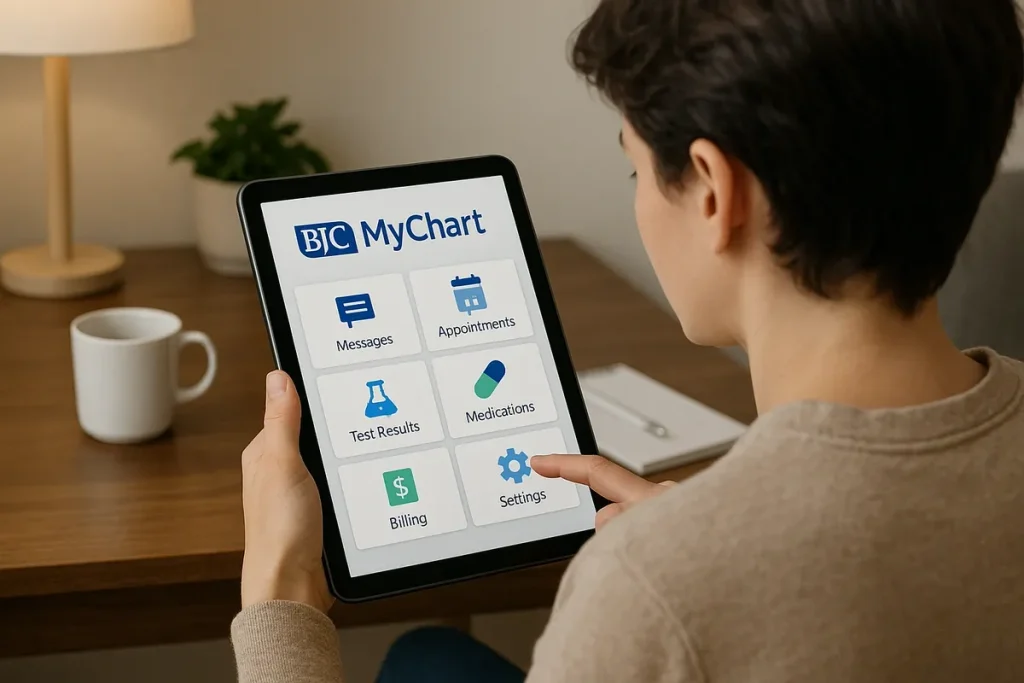
MyChart is a patient-facing portal developed by Epic Systems. Healthcare organizations that use Epic’s electronic health record technology can offer MyChart to patients for functions such as reviewing test results, communicating with providers, requesting prescription refills, and managing appointments.
That relationship creates an important distinction in the litigation.
Many lawsuits commonly described online as “MyChart lawsuits” have actually been filed against hospitals or healthcare systems accused of using third-party tracking technologies on their websites or portals. The fact that MyChart technology appeared in the allegations does not automatically make Epic the defendant.
For example, confirmed settlements involving Inova, Southern Illinois Healthcare, Memorial Health Services, Bayhealth, and St. Joseph Hospital concern claims against the respective healthcare providers.
Epic has faced separate litigation and regulatory scrutiny concerning other issues. Those matters should not be treated as the same legal proceeding as hospital-specific privacy settlements.
How the Privacy Allegations Developed
The central allegations in many cases involve third-party tracking technologies. These tools can help website operators measure traffic, understand user behavior, evaluate advertising performance, or analyze how visitors interact with online services.
Plaintiffs have alleged that certain healthcare organizations deployed such technology in ways that transmitted information associated with patients or portal users to outside companies. Depending on the lawsuit, allegations have referenced technologies associated with companies such as Meta, Google, or Microsoft.
The legal theories differ. Cases have invoked federal electronic communications law, state privacy statutes, consumer-protection laws, wiretapping statutes, and related legal principles.
The allegations should not be generalized across every healthcare provider using MyChart. Each lawsuit depends on the technology allegedly deployed, the information allegedly transmitted, the applicable law, and the conduct of the particular defendant.
MyChart Settlements Are Provider-Specific, Not One Epic-Wide Settlement
One of the most important points for consumers is that there is not one universal MyChart settlement covering every MyChart user in the United States.
Instead, multiple healthcare providers have faced separate cases.
| Provider or Health System | Reported Settlement Information | Claim Structure |
|---|---|---|
| St. Joseph Hospital, Nashua | $50 for valid claims | Provider-specific |
| Southern Illinois Healthcare | $17.50 cash benefit | Provider-specific |
| Bayhealth | $25 plus optional privacy benefit | Provider-specific |
| Inova Health Care Services | $3.147 million settlement fund | Pro rata |
| Memorial Health Services | $750,000 settlement fund | Pro rata |
| Cone Health | $1.765 million settlement fund | Pro rata |
These cases have different class periods, deadlines, courts, settlement administrators, and benefit structures.
A person who uses MyChart through one hospital therefore cannot assume that a settlement involving another hospital applies to them.
What a MyChart Settlement Typically Means for Patients
A settlement generally creates a defined group of people—known as the settlement class—who may receive benefits or whose legal rights may otherwise be affected.
The class definition can depend on factors such as the healthcare provider used, whether the person accessed a specified website or patient portal, and whether that activity occurred during a particular period.
Benefits have varied significantly. Some settlements provide a fixed cash payment, while others divide a net settlement fund among people who submit approved claims.
Certain settlements have also included non-cash benefits or changes in business practices. Southern Illinois Healthcare, for example, offered a cash payment and a privacy-related service, while Bayhealth’s proposed settlement provides a $25 payment and allows eligible class members to elect a privacy protection service.
Patients should therefore read the notice for their specific case rather than relying on a generalized payment estimate found online.
MyChart Class Action Lawsuit Claim Form Process
A claim form is generally required when a settlement provides benefits only to class members who affirmatively submit a claim.
The form usually asks the claimant to confirm that they fall within the settlement class. Depending on the case, a notice may contain a unique class member ID, login ID, PIN, or another identifier needed for online filing.
Some settlements permit both electronic and mailed claims. Filing electronically can provide an immediate confirmation number or email that should be retained.
Submitting a claim does not automatically guarantee payment. The settlement administrator may review submissions for timeliness, completeness, duplication, and compliance with the settlement agreement.
Where to Find the Official Claim Form
The safest source is the court-approved settlement website identified in the official notice or court documents.
Consumers should be cautious with social media posts, advertisements, or websites that promise unusually large payments. A legitimate settlement site should identify the case, court, administrator, important dates, class definition, and settlement documents.
For example, St. Joseph’s court-approved settlement site provides the class definition, $50 benefit, deadlines, and legal options available to class members.
Official notices may also provide a telephone number or mailing address for the settlement administrator.
What Information Claimants May Need
Requirements vary, but claimants may be asked to provide:
- Their name and current contact information.
- A class member or notice identification number.
- A PIN supplied with the settlement notice.
- Confirmation that they meet the class definition.
- A preferred payment method, when offered.
- A signature or electronic certification that the information is accurate.
Some settlements do not require documentation of financial loss. That does not eliminate the need to satisfy the class definition.
Claimants should retain their confirmation number, submitted form, emails, and any other correspondence until the settlement has been completed.
Who May Qualify Under MyChart Lawsuit Eligibility Rules
Eligibility is determined by the settlement agreement in the specific case.
Merely having a MyChart account is usually not enough to establish eligibility for every settlement. A claimant generally needs a connection to the particular hospital or health system involved and must fall within the applicable time period.
Official settlement notices provide the controlling class definition. They may also list people excluded from the settlement, such as certain employees, officers, judges, or people who timely opted out.
General Eligibility Factors
Common factors can include:
- Having an account associated with the defendant healthcare provider.
- Using a covered patient portal or website.
- Accessing the service during the defined class period.
- Falling within geographic or residency requirements, if applicable.
- Not being within an expressly excluded category.
- Filing a valid claim before the deadline when a claim is required.
The exact wording matters.
For instance, the Inova settlement covers qualifying people with an Inova MyChart account who visited specified public-facing websites during the covered period and whose information could have been disclosed through certain tracking technology.
How Provider-Specific Settlements Affect Eligibility
Provider-specific settlements prevent consumers from treating MyChart usage as a nationwide qualification standard.
A patient who used St. Joseph’s portal may fall within the St. Joseph class but not the Inova class. Likewise, a Bayhealth patient must satisfy the Bayhealth definition rather than eligibility requirements established in another case.
Bayhealth’s settlement, for example, covers patient portal users who used defined Bayhealth web properties through December 31, 2025, subject to the complete terms and exclusions.
Consumers should match the provider name, class period, and activity described in their notice before submitting a claim.
What Is Known About MyChart Lawsuit Settlement Amounts?
There is no single MyChart Lawsuit Settlement amount.
Confirmed settlements illustrate how widely the figures can differ. St. Joseph offers a $50 benefit to class members with valid claims, Southern Illinois Healthcare provides $17.50, and Bayhealth provides $25 plus an optional privacy-related benefit.
Other cases establish a common settlement fund rather than guaranteeing a fixed amount to each claimant.
Inova’s settlement established a fund of approximately $3.147 million, while Memorial Health Services agreed to a $750,000 fund and Cone Health agreed to approximately $1.765 million. Individual payments in pro-rata settlements depend on factors such as the number of approved claims and deductions authorized by the court.
A multimillion-dollar settlement fund should never be confused with the amount an individual class member will receive.
Why Are People Searching for a $2,500 MyChart Class Action Payment?
Searches referring to a “$2,500 MyChart settlement” can be misleading because that number does not represent a universal payment available to MyChart users.
One source of confusion is service awards. Courts may approve separate payments to named plaintiffs who represented the class. In the URMC litigation, for example, two named plaintiffs were reportedly eligible for $2,500 service awards, while ordinary class members received their shares under a different payment formula.
The same distinction appears elsewhere in class action practice: a service award for a class representative is not the standard benefit paid to every class member.
Published reviews of court-approved MyChart-related settlements have found ordinary claimant benefits substantially below $2,500 in numerous cases.
Consumers should therefore be skeptical of articles or social posts stating that every eligible MyChart user can automatically claim $2,500.
MyChart Settlement Payout Date Questions
Payment dates depend on the individual settlement.
Generally, payments cannot be distributed simply because a claim deadline has passed. A court may first need to grant final approval, and appeals or other procedural issues can delay the effective date.
The St. Joseph settlement illustrates the process. Its claim deadline was August 14, 2026, but the final approval hearing is scheduled for September 14, 2026. Payments are expected only after final approval and resolution of any appeals.
Memorial Health Services follows a similar structure. Its August 21, 2026 claim deadline precedes a September 17 final approval hearing.
Consumers should not rely on an unofficial website promising a precise payment date unless that date is supported by the settlement administrator or court documents.
MyChart Settlement Claim 2026: What Claimants Should Know
The 2026 settlement landscape remains active, but deadlines differ significantly.
As of August 22, 2026, some claim periods have already closed. St. Joseph’s August 14 deadline and Memorial Health Services’ August 21 deadline have passed. Other settlements may still have active claim periods.
For example, Cone Health’s preliminary settlement provides an October 5, 2026 claim deadline. The settlement covers qualifying individuals who accessed the Cone Health MyChart portal or completed certain website submission forms during the specified class period.
Bayhealth also has a proposed settlement covering defined patient portal users and provides a $25 benefit to qualifying claimants, subject to the settlement terms.
The practical rule is simple: identify the healthcare provider first, then verify the corresponding case and deadline.
How to Sign Up for a MyChart Class Action Lawsuit in 2026
People often use “sign up” to describe two different legal processes.
If a class action has already reached settlement, eligible class members generally do not hire a lawyer and separately join the lawsuit. Instead, they follow the settlement notice and submit a claim if one is required to obtain benefits.
A typical process is:
- Identify the healthcare provider involved.
- Locate the court-approved settlement website.
- Read the official class definition.
- Confirm the relevant dates.
- Review the settlement benefits and legal options.
- Submit the official claim form before the deadline.
- Save the confirmation information.
If no settlement exists for the consumer’s healthcare provider, there may be nothing to “sign up” for through a settlement administrator.
Consumers considering an individual legal claim should speak with a qualified attorney about their circumstances rather than assuming a class settlement exists.
Recent MyChart Lawsuit Update
Multiple healthcare privacy settlements have remained active during 2026.
Recent examples include Memorial Health Services’ $750,000 proposed settlement, Cone Health’s approximately $1.765 million deal, Bayhealth’s proposed settlement, and St. Joseph Hospital’s agreement concerning allegations involving its patient portal.
These cases reinforce the provider-specific nature of the litigation.
They also show that settlement status can change rapidly. A case may move from preliminary approval to a claim deadline, final approval hearing, appeal period, and eventually distribution.
For that reason, an article describing a settlement as “open” can become outdated quickly. Consumers should verify deadlines directly with the administrator before attempting to submit a claim.
St. Joseph Hospital MyChart Settlement in 2026
St. Joseph Hospital of Nashua, New Hampshire agreed to settle a lawsuit alleging that tracking pixels in its MyChart portal transmitted certain patient information to Microsoft without appropriate authorization.
The proposed settlement received preliminary approval on April 30, 2026. It covers individuals who used a MyChart patient portal account associated with St. Joseph during the settlement’s defined period.
Eligible class members who filed valid and timely claims could receive $50, with no proof of loss required under the published settlement terms.
The final approval hearing is scheduled for September 14, 2026. A settlement is not the same as a judicial determination that the allegations were proven.
The Claim Deadline Has Passed
The St. Joseph claim deadline was August 14, 2026.
Because the current date is August 22, 2026, that deadline has passed. The official settlement website also lists July 30, 2026 as the deadline for exclusion or objections and August 14 as the deadline to file a claim.
People who did not submit a timely claim should not assume that a late online submission will be accepted.
Questions about an already-filed claim, a missing notice, or deadline-related circumstances should be directed to the official settlement administrator using the contact information on the court-approved site.
How MyChart Lawsuit Settlement Discussions Evolved During 2025
During 2025, healthcare tracking-pixel litigation continued moving from allegations and contested cases toward negotiated settlements in several jurisdictions.
The URMC matter provides one example. A $2.85 million settlement received preliminary approval in April 2025 and covered hundreds of thousands of people falling within defined MyChart portal or public website groups. The claim deadline was July 21, 2025.
Inova also became significant during this period. Its approximately $3.147 million settlement received preliminary approval in December 2025 before the claims process continued into 2026.
These developments helped shift search interest away from the basic question of whether healthcare tracking cases existed and toward more practical questions: which provider settled, who qualifies, what claim form is required, and how much will individual payments be?
That distinction remains central in 2026.
What People Are Watching in MyChart Lawsuit 2026 Developments
Several issues remain important during the remainder of 2026.
First, courts must determine whether to grant final approval to settlements that are still preliminary. Final approval can affect whether and when payments become available.
Second, open claim periods continue for some provider-specific settlements. Cone Health, for example, has an October 5, 2026 deadline under its published settlement information.
Third, consumers are watching whether additional healthcare organizations resolve similar tracking-technology claims.
Finally, separate legal scrutiny involving Epic itself has created additional confusion in search results. Those matters involve different defendants, claims, and legal theories and should be analyzed independently rather than folded into one supposed nationwide MyChart case.
Epic Systems Faces Separate Legal Challenges in 2026
Epic Systems is facing legal and regulatory issues separate from the healthcare-provider tracking-pixel settlements.
Among the disputes is litigation involving Particle Health, which has accused Epic of anticompetitive conduct. Epic disputes those allegations and has raised its own concerns about Particle’s handling or access to health information.
Texas Attorney General Ken Paxton has also brought claims against Epic concerning alleged practices affecting competition and access to electronic health record data. Epic disputes those allegations.
These proceedings are materially different from class actions alleging that individual hospitals used tracking pixels on patient-facing websites or portals.
The fact that Epic develops MyChart does not turn every lawsuit mentioning MyChart into a lawsuit against Epic.
FTC Investigation in August 2026
A significant development emerged in August 2026 when Reuters reported that the U.S. Federal Trade Commission was investigating Epic Systems for possible antitrust violations.
According to the August 14 report, the inquiry concerns how Epic manages access to health data and whether its practices may hinder competitors. The FTC had not publicly commented on the investigation at the time of the report.
Epic has denied allegations that it improperly restricts competition and has stated that its technology supports interoperability.
An FTC investigation does not itself establish that Epic violated antitrust law. It is also separate from the patient privacy class actions against hospitals involving tracking pixels.
Those distinctions are essential when evaluating claims about an alleged nationwide MyChart settlement.
MyChart Epic Lawsuit Settlement: Are Epic and Provider Cases the Same?
No. They should not be treated as the same legal matter.
Epic develops MyChart, but healthcare organizations operate their own patient services and may configure websites, analytics tools, integrations, and related technologies differently.
Many privacy cases discussed in connection with MyChart name healthcare providers as defendants. The allegations concern how those providers allegedly deployed tracking technologies and handled patient-related information.
Epic’s separate disputes involve issues such as competition, interoperability, access to electronic health information, and relationships with other healthcare technology businesses.
A settlement involving Bayhealth, Inova, St. Joseph, Cone Health, or another provider therefore does not automatically create a settlement claim against Epic.
Consumers should always identify the named defendant before assuming two similarly described cases are connected.
How to Submit a MyChart Lawsuit Claim Online
For an active settlement, begin with the official court-approved website rather than a general MyChart login page.
The filing process commonly involves entering an identifier from the settlement notice, confirming contact information, certifying eligibility, selecting an available payment method, and electronically signing the claim.
Claimants should carefully check:
- The name of the defendant.
- The court and case number.
- The class period.
- The filing deadline.
- The required ID or PIN.
- The settlement administrator.
- The confirmation received after submission.
In the Inova settlement, for example, claimants could use the ID and PIN provided in their notice to submit a claim electronically, while a printable form was available for mailed submissions.
Never pay an unsolicited third party simply to access a settlement claim form that is available through the official administrator.
How to Check the Status of a MyChart Settlement Claim
The best place to check a claim is the administrator responsible for the specific settlement.
If the settlement website provides a claim-status feature, use the confirmation number, claim ID, or other credentials generated during filing. Otherwise, contact the administrator using the official telephone number, email address, or mailing address listed in the notice.
Keep copies of:
- The claim confirmation.
- Settlement emails and notices.
- Your class member ID.
- Any payment-selection confirmation.
- Correspondence with the administrator.
A claim that shows as submitted is not necessarily ready for immediate payment.
Final court approval, claim validation, administrative processing, and appeals can all affect distribution. Claimants should therefore distinguish between claim status and payment status.
The Broader Impact on Healthcare Privacy
The litigation highlights a broader issue: ordinary website analytics tools can create more complicated privacy questions when deployed in a healthcare environment.
A tracking technology that appears routine on a retail website may create different legal concerns when a visitor’s interaction can be connected with healthcare services, medical providers, patient accounts, appointment activity, or other sensitive information.
The litigation has also placed greater attention on how healthcare organizations audit third-party scripts and analytics technologies.
Hospitals increasingly have reasons to examine what information a technology collects, where it is transmitted, whether consent is obtained, and whether the arrangement complies with applicable federal and state privacy requirements.
The cases do not establish that every tracking technology violates healthcare privacy law. Liability depends on the facts, information transmitted, consent mechanisms, statutory requirements, and other legal circumstances.
What Patients Should Do If They Receive a Settlement Notice
A legitimate settlement notice should not be ignored.
Start by reading the class definition and confirming that the notice relates to a healthcare organization you actually used. Then compare the deadline and benefits with the information published by the court-approved administrator.
Patients should:
- Verify the official settlement website.
- Read the notice before submitting information.
- Confirm eligibility and class dates.
- Review the available legal options.
- File before the stated deadline if seeking benefits.
- Save confirmation records.
- Avoid websites making unsupported payout promises.
A notice can affect legal rights even when the recipient chooses not to file a claim. Depending on the settlement and timing, class members may have options concerning exclusion or objections.
Anyone with questions about significant individual losses, separate legal claims, or the effect of a release should consider consulting an attorney.
Read: Generational Equity Lawsuit
Read: Trellis Law
Read: Fischer Homes Lawsuit
Read: Venmo Class Action Lawsuit
Read: Exploring CNLawBlog
Frequently Asked Questions
Is there a MyChart lawsuit settlement in 2026?
Yes. Multiple healthcare providers have reached separate settlements involving allegations about tracking technologies connected with MyChart portals or healthcare websites. There is not one nationwide settlement covering every MyChart user.
Is Epic Systems paying every MyChart user a settlement?
No. Available settlement records do not establish a universal Epic payment to all MyChart users. Many widely discussed cases involve individual hospitals or health systems rather than Epic itself.
Can I receive $2,500 from the MyChart class action?
Not automatically. The $2,500 figure has appeared in some cases as a service award for named class representatives. Ordinary claimant benefits in confirmed settlements use different payment structures.
How do I know whether I qualify for compensation?
Check the official class definition for the settlement involving your healthcare provider. Eligibility usually depends on the provider, portal or website used, relevant dates, and any exclusions contained in the settlement agreement.
Where can I find the MyChart settlement claim form?
Use the court-approved website for the specific provider settlement. Official notices normally identify the administrator, claim form, deadlines, case information, and any ID or PIN needed to file.
When will MyChart settlement payments be sent?
There is no universal payout date. Distribution depends on the specific settlement, final court approval, resolution of appeals, validation of claims, and completion of settlement administration.
Final Thoughts
The MyChart Lawsuit Settlement landscape is best understood as a collection of separate healthcare-provider cases rather than one nationwide lawsuit against MyChart or Epic Systems. Several confirmed settlements concern allegations that tracking technologies transmitted patient-related information to third parties without appropriate authorization, but the defendants, class periods, benefits, and deadlines vary.
Some 2026 claim deadlines have already passed, while other provider-specific proceedings remain active. Claims about guaranteed $2,500 payments or automatic compensation for every MyChart user should be treated cautiously unless supported by official settlement documents.
Patients who receive a notice should rely on the court-approved administrator, verify deadlines, preserve filing confirmations, and carefully review how the settlement affects their rights. Allegations remain allegations unless established through evidence and legal proceedings, and a negotiated settlement does not by itself constitute an admission of wrongdoing.